toody cole could not be less interested in retirement
Sitting in the home she built with the late Fred Cole in Oregon, the Dead Moon hero sat down for a chat ranging from her childhood to the Rats to her latest EP.

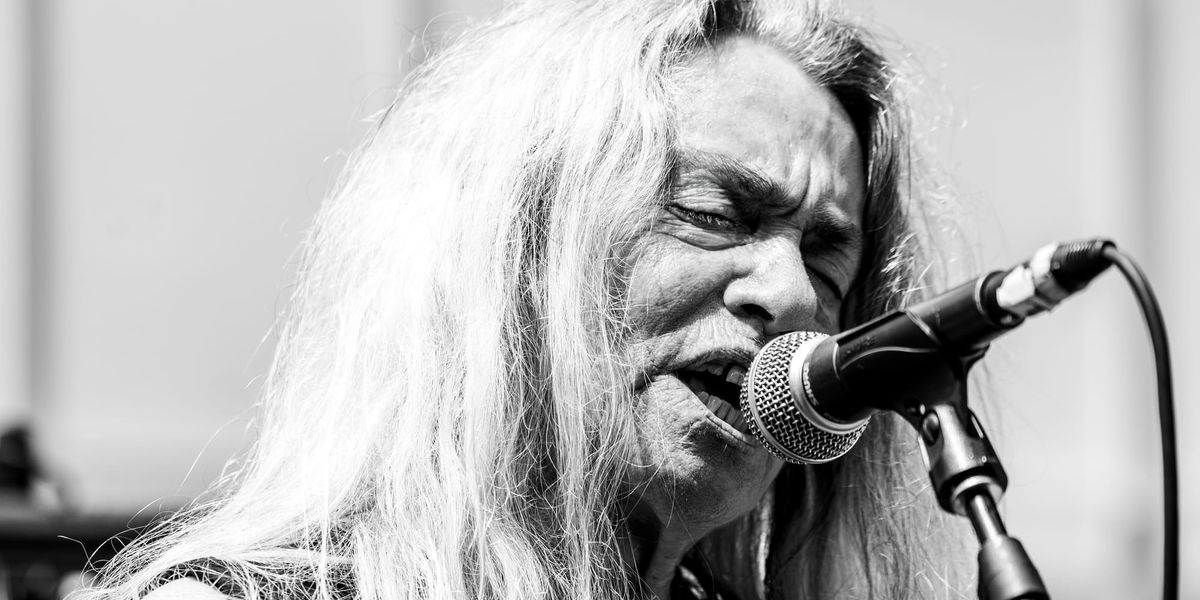
Before my drive from Seattle to the outskirts of Oregon City, Toody Cole sent me a detailed list of directions to ensure I didn’t get lost finding her home. But I knew I was in the right place when Google Maps closed its navigation. After spotting the mailbox with her surname on it, I drove down the long driveway and found a rather large version of the Dead Moon logo looming high above the doorway. It might have been difficult if I were scheduled to meet literally anybody else.
I was greeted with a joke and Toody’s signature cackle, which punctuates much of our conversation. When we sat to talk, she offered me a Bud Light; no amount of beer snob in me would ever allow myself to turn down the chance to drink a brew with Toody Cole. The sky beyond the vast expanse of trees grew dark as I listened to her stories, something I could have done for much longer than I did.
Where I’m from, Toody Cole needs no introduction. Alongside her late husband Fred, they helped define Northwest rock’n’roll music. Not just for their generation or may generation or yours—they changed it forever. Many of the most enduring and significant bands to ever come from this region—Nirvana, Mudhoney, countless others—took cues from Dead Moon’s playbook.
Before we sat down for our hourlong interview, Toody took me on a tour of the home she shared with Fred, a house they and a friend built with their own hands before I was born. It could essentially double as a museum if Toody wanted; so much punk history existed within those walls. Countless show posters; reel-to-reels and instruments and recording equipment in various states of disuse; the mythic lathe on which every Dead Moon LP and single—and, astonishingly, the Kingsmen’s iconic version of “Louie Louie”—was cut.
As we sat at Toody’s dining table, domestic beers perched in front of us, we began a career-spanning conversation, covering fifty years in the life of an honest-to-goodness punk rock icon. We spoke about the bands Toody and Fred played in together (the Rats, Dead Moon, and Pierced Arrows), memories of Portland’s punk scene over the course of several generations, the origins of her recent Pinky Tex EP, and why it’s still important to her to play “Dead Moon Night” at 77 years old.
Were the Rats the first band you had ever played in?
Yeah, that was the first time I’d played in a band, and the first time I played bass guitar as well.
What led you to that? Was it Fred?
Fred. He had just finished up with Zipper, where he was just doing lead singing. And then he did another version where he started playing electric guitar called Zap Spangler. Then he just kinda tried a little bit of this and that. He couldn’t find anybody that he was comfortable with. And when he was playing in King Bee, they got lucky enough to play a slot with the Ramones at the Paramount way back.
And after he saw the Ramones, he just went, “Man I gotta play something with some energy to it.” They were doing swampy, rhythm and blues kind of stuff before. And he was just tired of auditioning guys and looking for bass players, and he started out as a bass player.
So he just said, “Hey, I’m gonna teach you bass.” And I go, “Oh, OK.” [laughs] “Yeah, we’ll see where this goes.” He was just starting to play guitar. Our drummer had never played before, so we were all starting at ground zero, like all the other 15-year-old kids that were coming into the music store [we owned]. He showed me some super simple licks and we had a few cover songs that we were messing with. And a couple of originals, I think.
But anyway, we just played for a house party a couple weeks after that. And after that, we were just playing pretty much as often as we could get booked. There was a lot going on at that particular point, so we’d go and just hit the route and play Portland, Eugene, Seattle, and Vancouver. We played up there a lot, too. Everybody was just going up and down the West Coast, and all the California bands would come through, and you’d hope to god you got on one of their shows, and we played with most of those bands several times.
What were some of your favorite bands you played with over the years?
D.O.A. Black Flag was cool. Trying to think of who else. We played with D.O.A. a lot actually, and got to know Joey Shithead real well. Sado-Nation was great. We played with the Wipers a bunch of times. The whole music scene here in Portland right then was just…phew.
What was everybody listening to in Portland? Because I know that’s when the Portland punk scene was bubbling up with the Wipers, the Neo Boys…
Every town’s punk scene was. We just had a lot of bands that came out that made a name for themselves. At that point, the kids that ended up in Poison Idea, especially Jerry A., were like 15, 16, 17 years old coming into the music store. I feel like I grew up with 90% of them. But it’s cool. Jerry’s still kicking around the scene and doing stuff. He’s a great guy.
I think everybody was listening to a little bit of whatever, and a lot of the musicians that were Fred and my age—and Greg Sage was a little bit younger—they all had the same influences growing up. So there was a thread to what everybody did, but we were born in ’48; so was Iggy Pop, so was Ozzy, so was Robert Plant. Everybody had those same influences, but they all took it someplace else, and all those lead singers just had their own unique style, which is what really has amazed me.
And the same with the punk rock stuff. Everybody just went off on a different tangent. One of the coolest things about the Portland punk rock scene to me was how diverse it was, because in a lot of other scenes, it was just “thrash, bash, yell, scream.” A lot of the bands here did that too. But there was a lot of other stuff going on, too, as far as music and lyrics. Some of it political, some of it not. But it was a real wide range of stuff, really.
What was Portland like culturally? I’ve been living in the Northwest for a pretty long time now, and I’m fascinated by what the cities and the communities were like before I came around or before I was born.
What year were you born?
1983, but I moved to Tacoma in ’98.
That’s funny, Fred was born in Tacoma.
Yeah, that’s something I didn’t know.
Back then [when I was a kid], there was nothing out there but berry fields when they first started putting houses out there [in Portland]. At that point it was the whole postwar element of kids working—you picked berries, you did this and that. You made money and you were expected to do that every summer.
And we were all from large families. No birth control [laughs]. I’m from a Catholic family, so was [Dead Moon drummer] Andrew [Loomis], so we’re each from a family of seven. If you wanted anything, you had to go out there and get it yourself, and work for it, which is awesome. I wish kids now had a bit more of a work ethic. We were forced into it, but glad for it.
Anyway, Portland itself was considered a small city at that particular point, always overshadowed by Seattle. Now, we’re probably about the size Seattle was back then, maybe even a little bit bigger, and Seattle’s just like L.A. used to be to me. Cities have adapted and changed.
Portland’s always had a really hardcore artistic scene. Not just for music, but for photography, dance, playwriting—pretty much the whole gambit has always been applauded and nurtured here in town. And it’s got a real cooperative scene as far as all those elements go, and especially everybody involved in music as far as who I grew up with.
When I first started going downtown, it’s when it was all folk music, Dylan, Joan Baez, jug bands. And there were several different coffee houses, one of them being The Folk Singer, which is where I met Fred. Music is always evolving and coming back around on itself and making a new twist on stuff. Portland’s changed, just like every other city. It became huge. Dope became a problem everywhere. I think the Vietnam War really started unfortunately, and it just snowballed from there. Unfortunately, Americans have a huge appetite for everything that’s not good for them.
Luckily, Fred and I married young, had kids really young, and had to be responsible. So we missed out on, on ... Not missed out. I’m glad we didn’t indulge. It was just, at that point, man, people were getting thrown in jail for 25 years for smoking pot and having their kids taken away.
Wow.
It was hardcore, heavy duty shit. It was scary. And there was such a huge element that wanted to basically rid the planet of anything that looked like a hippie, so it was like you were fair game. I always laugh when they say “the Summer of Love,” ’cause it was insane.
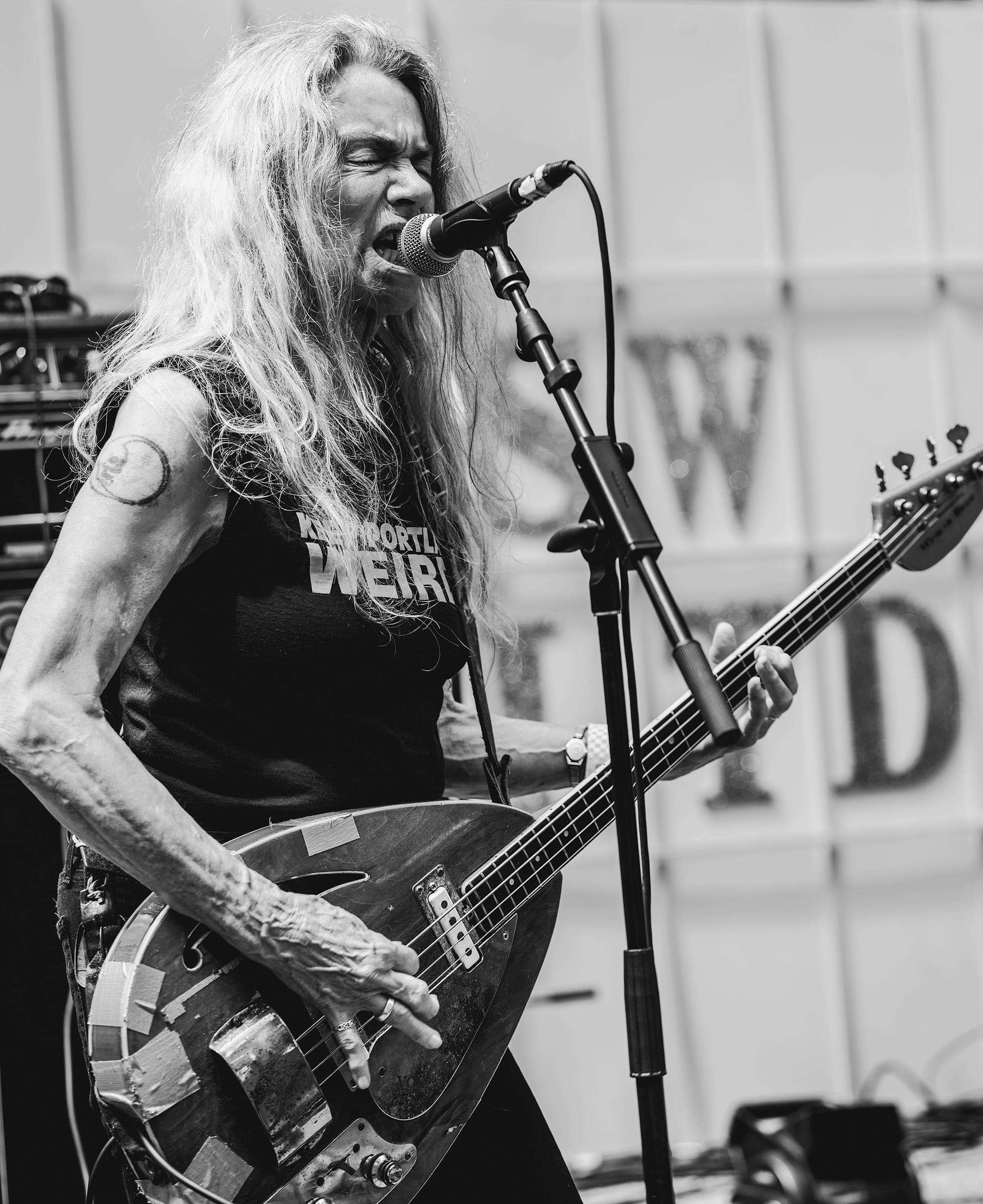
So what inspired the transition from the Rats to Dead Moon?
We did the Rats and went through three different drummers. Our first drummer, Rod, we just outgrew him in a way—and he ended up committing suicide, which was really hard to handle. And then we played with Sam Henry, which was amazing. He was from the original Wipers lineup. It’s really weird when you play with somebody that’s that good. They just raise the bar, and you go up to meet it. So we really gained a lot of variation in what we were doing and the kind of songs that Fred was writing.
Fred anticipated something really amazing happening with the Rats, and it never did. We never really went anywhere, never got a huge rep around town. We played a lot of great shows and made friends with all the different musicians. We were always involved in the scene partially because we were playing, but a big part of it was the fact that we had a music store downtown that catered to everybody. We were cheap and friendly and gave everybody access to inexpensive instruments to start playing on. We also helped organize Clockwork Joe’s, which was an all-ages venue downtown that was a co-op kinda situation.
So we were involved in all that stuff and took over a lot of the business end of stuff, which most musicians have no knowledge of. We both happened to just luckily be naturally inclined to go there, to do that, and to love the challenge of that.
But yeah, most of starting Dead Moon was that Fred really wanted to get back to his basic rock’n’roll roots that had started out with the Weeds which became the Lollipop Shop, going back to pure rock’n’roll again.
And so we did that and we pretty much started out just playing nothing but covers, and then started working on original stuff, and we actually had three albums worth of stuff before we ever started touring. Satyricon was our home base. We played all the clubs that were going on at that particular time, and built up a good following here in Portland.
At some point, it just became this huge cult thing. Part of it was our story, our lifestyle, and the fact that we treated the band like family, which it was. We looked like crazy brothers and sisters up onstage together. I’m not quite sure what it was.
I always say it was just magic, and I can’t explain it. It was all spontaneous, so which is the best way to be.
One thing I think about when I listen to the music, the first two records especially, is that Dead Moon doesn’t get enough credit for inspiring what came after—particularly the grunge scene.
All those kids would come and watch the Wipers and Dead Moon both. And so I know what a huge influence especially that Greg was to Kurt Cobain, just because they were both left-handed and whatever, and it has that same droney thing going on. But there were a lot of the other bands; I’ve told Fred that at different points what a big influence he was. And he’s the first one to go, “God, don’t call me a fucking legend.” He hated that stuff. But by the same token, he totally deserves it.
To me he’s still in that top ten of rock’n’roll vocalists and songwriters. I’m still his biggest fan. I’m amazed that anybody can write songs, ’cause I don’t have that talent. I can’t do it. I’m more of a musical technician, learning what I need to know. That’s as far as my talents go; thank god it’s still enough to get me by. I think my vocals have gotten better with age, but I think everybody’s does. Or you have a better feeling for what you’re singing about.
Talking about your first few records, we’ve gotta get into some Dead Moon lore, starting with the lathe that was used to cut the Kingsmen’s version of “Louie Louie.”
It actually cut the demo. It was actually up in the studio at KSAN Radio. And back then, the DJs would have to cut all their little commercials or whatever. This is pre-tape stuff. So that's what it was used for. And the Kingsmen’s first manager was one of the big disc jockeys in town. I think it was Roger Hart. They just went up to the station and evidently cut the original demo on this lathe cut.
Wow.
You take an acetate and it’s just a one-off. It’s got a metal disc in the middle of it, and you can play it about 100 times before the grooves wear out. But it also cuts master lacquers, which is what they press the vinyl records off of once they make a master out of them.
And you bought that for Fred, correct?
I weaseled it out of ... it ended up in the basement of a recording studio, all taken apart and in boxes and bags and whatever. Fred heard about it and tried to buy it off of the people that had it. They go, “Man, you don’t want that. It doesn’t work. It’s all in pieces.” And they wouldn’t do it. So before one of his birthdays I thought, “Oh, last ditch effort. Maybe they’ll let a girl have it." We get away with a lot, as you well know, I’m sure [laughs].
So I just pleaded my case and said, “Oh, man, he’s been hounding you and his birthday’s coming up, and it might not work, but he loves messing with stuff and putting stuff together.” So they finally said, “Yeah, OK, fine. Give me 200 bucks and it’s yours.” You saw how big that thing was. I still remember huffing it up that staircase, OK?
Oh my gosh.
With him pulling and me pushing, OK? And it weighs like it’s just a solid ton.
It was just the two of you?
Oh, yeah. We did everything together. Back then hard work was an everyday affair. Hard labor. Luckily he got it all in there, got it up in that bedroom. The room was empty. This is when our kids had already all moved out, and so he just messed with it, and it took him two to three months. Luckily there was a Xeroxed manual included with all this stuff, so he just went through everything and just kept tinkering with it until he finally got a hum out of it, and then a noise—not a good noise [laughs].
And he just kept at it and at it until he figured it out and fine-tuned everything in there. Then he cut an acetate of “Parchment Farm,” which was a cover that we were doing from memory. And we put it on the Satyricon jukebox, which I have in the other room. It doesn’t work either. Not anymore. But yeah, that was the first thing that he did, and then he finally cut the master for the first 45 that we put out, which was “Parchment Farm.”
All of the Dead Moon stuff was cut on that thing?
Yeah.
How did that first Holland tour come about and how did you all become big in Europe?
I gotta put it in context because all you kids have no clue. I grew up when nobody had a television set, OK? You had to go over and watch it with somebody else who had more money than you. There were three channels. This is before the internet. Shit, all we had was cassette tapes.
Everybody used to send cassette tapes back and forth with different bands they’d heard to turn somebody else that was their buddy or pen pal or whatever onto it. So evidently somebody had done that and sent it to somebody in Holland, and the guy that was the manager of Vera Club in Holland—in Groningen, which is up north from Amsterdam—was having a 10th anniversary of him being the head honcho there.
And he’d heard about us from whoever, and I think it was also probably from the Wipers as well, and some of the the few of the Seattle bands like Mudhoney, who had toured there right before us. So I think a lot of that was because of different Northwest bands that had mentioned us as well. But anyway, he heard and he had sent us a fax and invited us to come and play and gave us this ridiculous budget. Especially for us back then, so we could fly over there and blah blah blah and play this big party he was having. We said, “Fuck yeah, let’s go."
What was cool about it, just ’cause back then everything was just word of mouth, it was a friend telling a friend, “Hey, you gotta go check this band out,” OK? There was no social media and nothing else. So it was the best way to get a good rep when a friend tells you, “Hey, go check these guys out,” and then from there it just kinda snowballed really, and it was just I don’t know. People were just either loved us or didn’t get it. Most people were just like, “Whoa, what the fuck was that?”
While you were touring Europe, that’s where another big piece of Dead Moon lore came from—that you burned a candle and would play until the end. Where did that come from?
Oh god. Another vicious rumor. There was a bunch of them. One of them that was actually in the press was that me and Andrew were married. We were all vegetarians and we only drank milk. And we actually went—I think this is in the doc [2006’s Unknown Passage: The Dead Moon Story]—we actually went backstage at one point after that was out and we opened up the thing and there’s nothing but salad and milk. And we’re like, “What the fuck?” We were hardcore meat eaters, and bring me the booze, OK? But yeah. The thing with the candle is great because at that point, Whedon, my son, was living upstairs. He was, like, 20, 21, and came on those first several tours and was doing merchandise sales for us and, just pumping gear, being a roadie and Andrew’s roommate.
But anyway Andrew started out with this full kit, and the first tour, he threw the ride tom in the back of the van. I went, “Fuck, I’m not carrying that goddamn thing. I never hit it anyway.” And he had an old Ludwig kit, which I don’t know if you’ve ever seen this, but they have this big hole on the top of the drum where the tree to hang the toms on is supposed to be. So he only used a snare, a floor tom, and a bass drum. So there was a big hole there, and at one gig—we had a bottle of JD in our rider, and most times we got it. We would have crates full of partially used Jack Daniels. Fucking insane.
We were getting near the end of a show and Whedon found a bottle of JD on the dance floor, I think, and he just went up and turned it upside down. He actually started it, turned it upside down, and shoved it in the hole. At some point, Andrew added the candle, and it just kinda became a thing, and Fred was very superstitious. If anything worked, he wanted to keep doing it.
So that’s how that happened, and then some fan came up with this whole idea of, “Yeah, they’ll play until the candle burns out.”
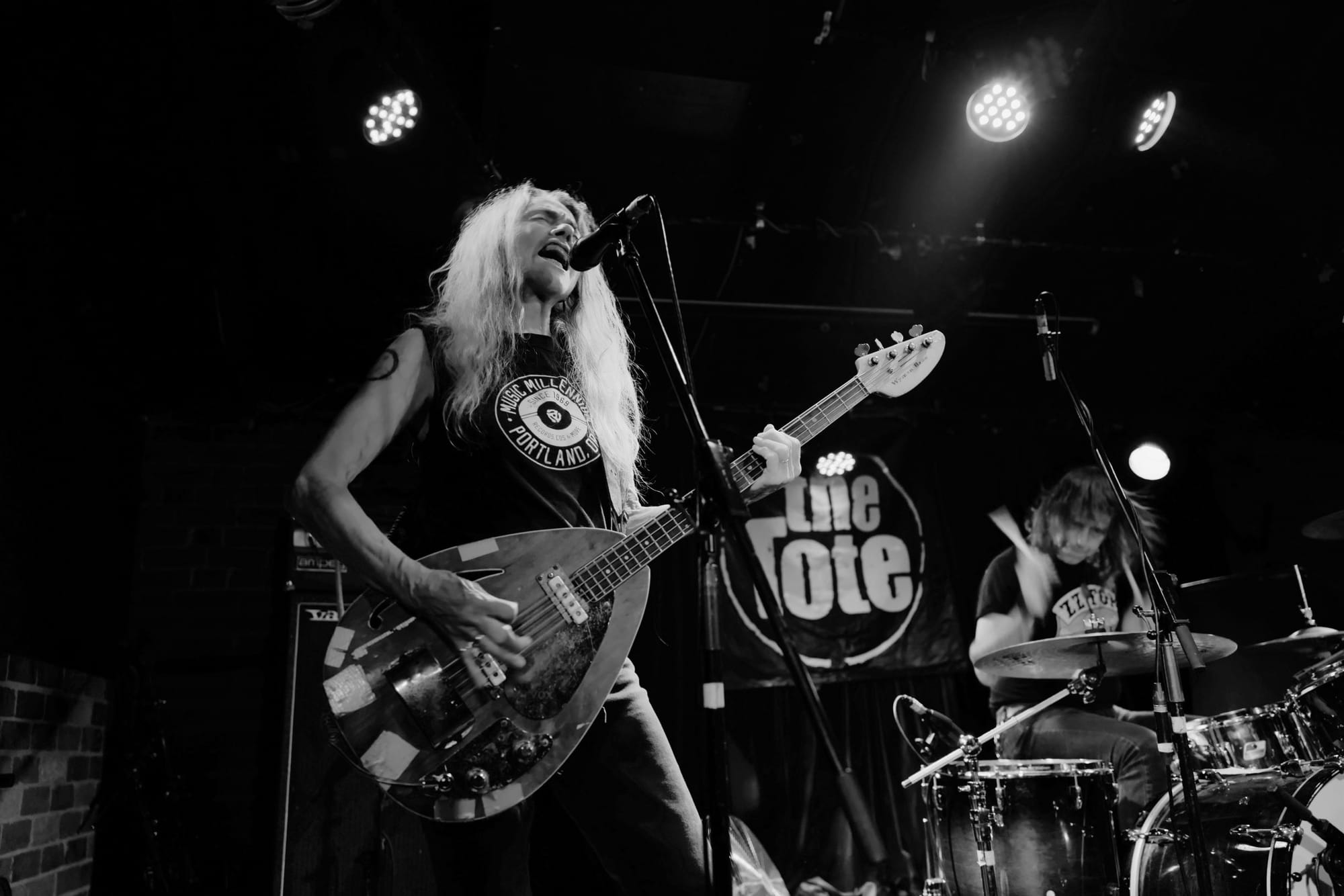
Moving on to the mid-’90s, that’s a period when the Northwest scene was undergoing a transition. The industry has come and picked up all the grunge bands and discarded them, and now, there’s post-grunge. But the Northwest scene is more cloistered, and Dead Moon stayed consistent through that. Did you see a downturn during those years?
Yes and no. You could just sense it. Changes were coming. Luckily for us, our heyday was in the first half of the ’90s. And a little past there—’96, ’98 even. But even at that point, you could see that the whole house music thing was becoming such a big thing in Europe and every place else.
You’d go to the club that you were gonna play two years prior and you’d have people lined around the block to get into your show. And [two years later] you’re driving by these house DJ things or whatever—house music boom—and the kids were lined up around the block for that. It’s just the natural evolution of stuff.
Luckily for us, we hit a point when live music was at its heyday pretty much everywhere. All the clubs had live music seven days a week. Pretty much everything was always packed out. Everybody was going out to see bands, even bands they’d never heard of before. We were really lucky to be a big part of that, and also double whammy, to be from the Pacific Northwest, which everybody was curious as hell about.
And to be included in that whole scene of all the bands that had come out of Seattle and Portland both, it was, great time for a band like us to be alive. And just from the way and the age that Fred and I both were even then, it's comical to look back on it now and the first question everybody would ask you was, “You’re 40 years old. Aren’t you too old to rock’n’roll?" [laughs] Seriously. And we’re like, “What?” I don’t think anybody had any idea of the longevity our generation was gonna have in rock’n’roll.
Fred once said that Pierced Arrows was a way to bring the Rats back. Do you feel like it was more of an evolution or a continuation?
It was both. When I first started getting familiar with the songs—’cause he’d been writing a bunch of those songs, and there’s a couple of them that we were gonna try working up with Dead Moon, but just never really gelled. The whole fact that it’s really syncopated and there’s a couple of different things where he had me sing—like “Zip My Lip”—and that are basically, punk rock kind of songs, but not exactly the same as before. I can see that, I can see that correlation.
And there’s a ton of stuff that he wrote in the Rats that are really great songs that would probably be cool at this point to go back and mess with. But I’m doing a couple of them with the thing that we’re doing now [Toody Cole and Her Band] just because at first, I wanted to start out with stuff that I had originally sang vocals on.
There’s a bunch of stuff. I’m working on some harder stuff, but there’s a lot of stuff where the bass parts are so busy—to try to sing lead vocals over the top of those while you're doing them at the same time is just… ugh. But I’m getting a couple of them, new ones that we’re gonna throw in there. It’s a work in progress.
Do you feel that the main appeal for Pierced Arrows was like, “Hey, we’re doing these new songs,” or did you think that people came out because it was you and Fred?
Mostly because it was me and Fred, and they wanted to see what came next. A lot of people were like, “Whoa, why did you end the band? Oh my god.” And the first show that we did as Pierced Arrows was here in town at Ash Street with the latest version that Jerry A. had going on with Poison Idea at the time. So it was like this huge show where “ex-Dead Moon” plays with Poison Idea again.
And Jerry was really good about getting a good collection of musicians together to redo Poison Idea. It became the running joke of Portland for many years, the “final” Poison Idea show. It was packed. There were literally people around the block, sold out. That was awesome, and we thought, “OK, cool. Here we go again.” And we basically did get a lot of offers and a lot of people that we’d worked with before in the U.S. and everywhere else book tours for us just because of the rep of Dead Moon, and the fact that Fred and I were in the bands.
Going a little farther into the future, let’s talk about your solo career. There’s this new Pinky Tex EP.
Oh, that’s not my “solo career.” This is just a crazy project when nothing was going on. Sonny Smith, who did this, is a friend of Eric Isaacson from Mississippi Records, who's a super good friend of mine. Of course, Mississippi does all the Dead Moon reissue albums. He turned me onto this guy, and he goes, “Man, I’ve got this friend from the Bay Area who really wants to do something with you, Toody.”
I’m not one to collaborate with anybody. And he kinda does these weird projects where he picks a musician that he admires, he makes this whole background story for them and writes a couple of songs, has you learn them, and I’m like, “Oh, man.” And the more I thought about it, I was like, “Oh, I don’t wanna do this. This is not my thing.”
But as it went on, it kinda became a favor for a friend, and it kinda happened. And I really didn’t even know if he’d even put anything out. Sonny was up here a couple of different times, and he sent me the tape or whatever of the two songs that he wrote, “Palmreader” and “Long Corridor,” and just had me listen to them and figure out the vocals. And he sent me the lyric sheet.
But anyway, he came up here, and we just recorded it live here, and I couldn’t really figure out any bass parts for it that worked, so he had ended up having me just sing everything a cappella. And then he ended up recording all the guitar and bass parts on the songs. I think his wife sang backup on some stuff. He said he wanted to make it like a country kinda thing, which I thought was cool. And he goes, “So I need you to come up with a name of what you wanna call yourself, and I’ll come up with a background story.”
And he asked me a few questions like you’re doing, and was asking me a little bit about the summer Fred and I took off and kinda did just nothing but country stuff as a duo with a drum unit through the summer of—what was it, ’85, I think—down in Nevada and the old Gold Coast.
Was that the Western Front?
No, that was after Western Front. This was just him and me just down there for the whole summer singing for our supper and, traveling around in our beat-up old van. And so that kinda was kinda the basis for the story. So he asked me for a name, and while we were doing Western Front and a bunch of different stuff. I love Kate Hepburn, so one of our favorite Spencer Tracy/Kate Hepburn movies that we used to watch was Adam’s Rib, and they called each other Pinky. So he called me Pinky and I called him Tex during that period. So that’s where Pinky Tex comes from.
That’s really cool that it was a Sonny Smith thing. I really like Sonny & the Sunsets.
Oh, that’s cool, I have never heard his band. We were hoping to get something together ’cause they’re gonna close down Bottom of the Hill at the end of the year, and we used to play there. Dead Moon, that was our spot forever and ever. But unfortunately we’re gonna be in Europe at that particular point. when they had an opening, and it just isn’t gonna kinda work out. But yeah, I guess he’s done this with a bunch of other people over many years, so it’s a side project that he’s had ongoing, which is cool.
Yeah, he’s a creative guy. And it also reminds me a lot of the punk-to-country pipeline. I’m thinking about Jenny Don’t and the Spurs; lots of punks get into country music.
God, yeah, and it’s really cool. I love that stuff. To me, the Range Rats album is still pretty much my favorite album we ever recorded. It’s awesome. Some really cool shit on there.
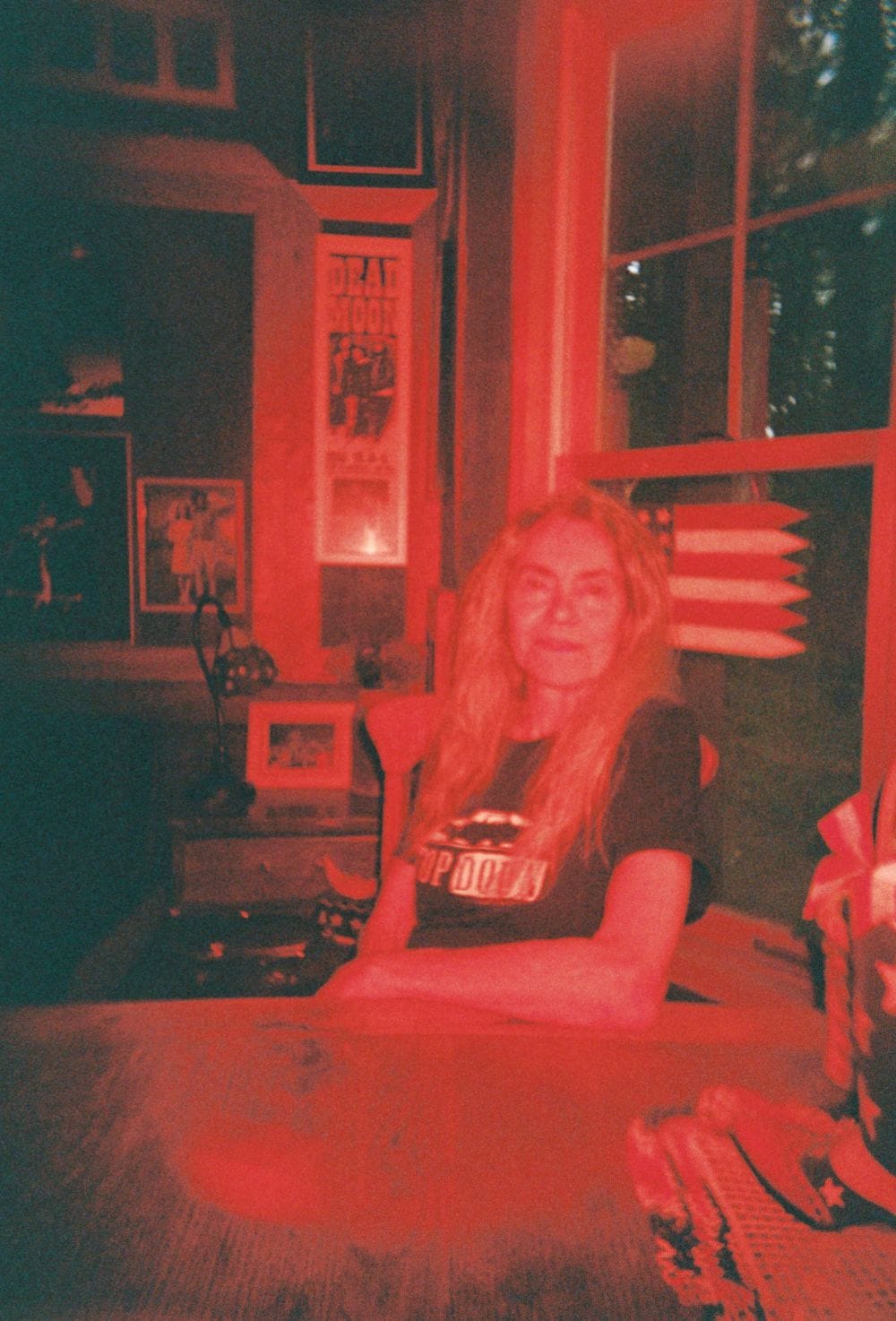
Last question for you: What’s next? You are 77 years old. I get the impression that if you were gonna sit in your rocking chair and let the world pass you by, you would’ve started doing that already. You’re playing Woodsist Fest, Gonerfest, U5 Fest, and you’re going to Europe.
Yep, yep. We’ve got a ton of stuff going on this particular year. As far as after that, Kelly [Halliburton] and Jenny from the Spurs are pretty much handling all this stuff, and they’ve got their agents booking what we’re doing. I told Kelly, “Don’t book anything for next year, ’cause I really am not sure exactly what I’m gonna wanna do.” At different points, it’s getting harder and harder for me to play bass and do the vocals, too. At some point I may decide, but I really shy away from the fact of having somebody else play those bass parts, ’cause to me, it’s the last vestige of what Dead Moon should really sound like.
I may get turned on to something else down the road. So I don’t know. We’ll see. Your guess is as good as mine. And I get the whole thing with, “OK, Neil Young is out there doing it and he’s 80, so what’s your excuse?” I was like, “I guess I don’t have one yet.”
You can find more of Martin Douglas’ writing over at his newsletter Trick Bag.
see/saw is a reader-supported publication. If you enjoyed this piece, please share it and subscribe.