smirk’s speculative fiction is based on a true story
Finding strange facts in fiction and mapping the band’s secret history with Ringo.
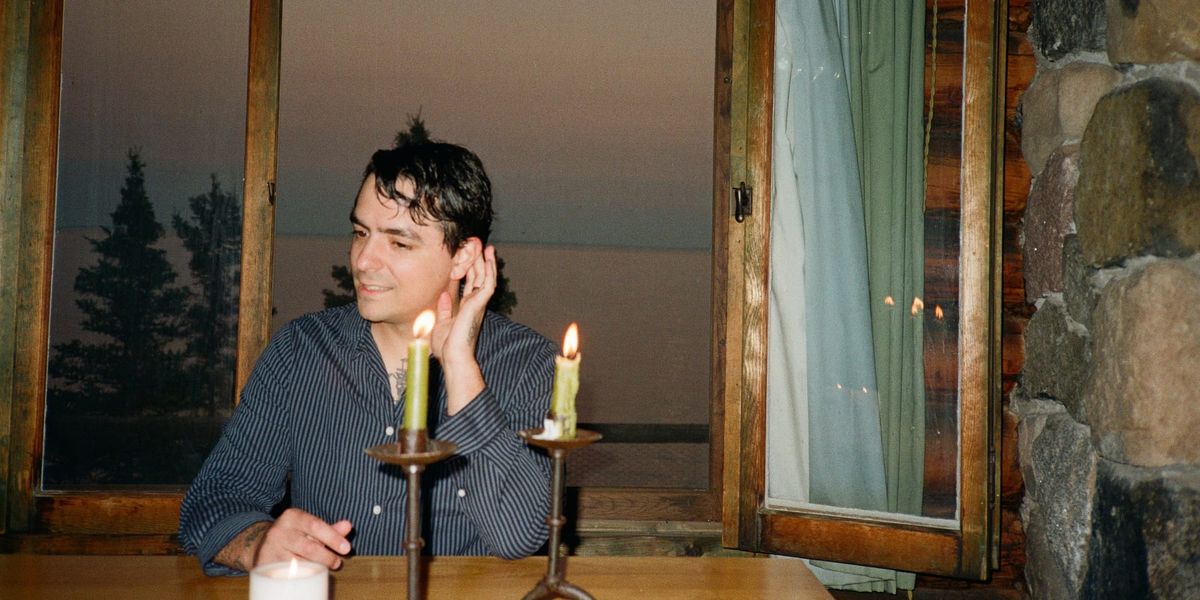
Nothing is as it seems when it comes to a smirk. That expression is nothing if not deceitful. A smile that really says, Fuck you, and is rarely reciprocated except when duped by — or in cahoots with — the one doing the smirking. Smirk the band, by contrast, is less of a band than the lifer (thus far) Nick Vicario, who grew up in Portland, Oregon — but also Northern California — where, from teen age, he cut his teeth playing in punk and hardcore bands, and hardcore punk bands — but also would study audio engineering and lead a promising synth pop group poised for commercial success.
It’s right on the money that the jacket art for Smirk’s new album, Speculative Fiction, only gradually revealed itself to me after numerous double takes. First, the portraits painted on the front and back covers: a partially obscured but menacing figure holds the warehouse door for a couple humanoids on motorbikes in a scene out of a J.G. Ballard story; and a pair of strapping arm wrestlers on a train who’d be at home in a John Steinbeck novel—are actually photographs. A closer look only obscures where the painted murals and their cracked and weathered surfaces begin and end. Second, all of the drippy-blood hand drawn lettering that graces the album art is also barbed wire.
It’s hard to say which revelation from the following interview with Smirk will most thoroughly capture reader’s imaginations and inform how Speculative Fiction can be heard. Personally, I just hope to be around for the day Smirk’s behind-the-music story gets the Hollywood dramatization it deserves. Maybe then Nick and the singer from Trapped Under Ice will play themselves in the Origin Story of Smirk?
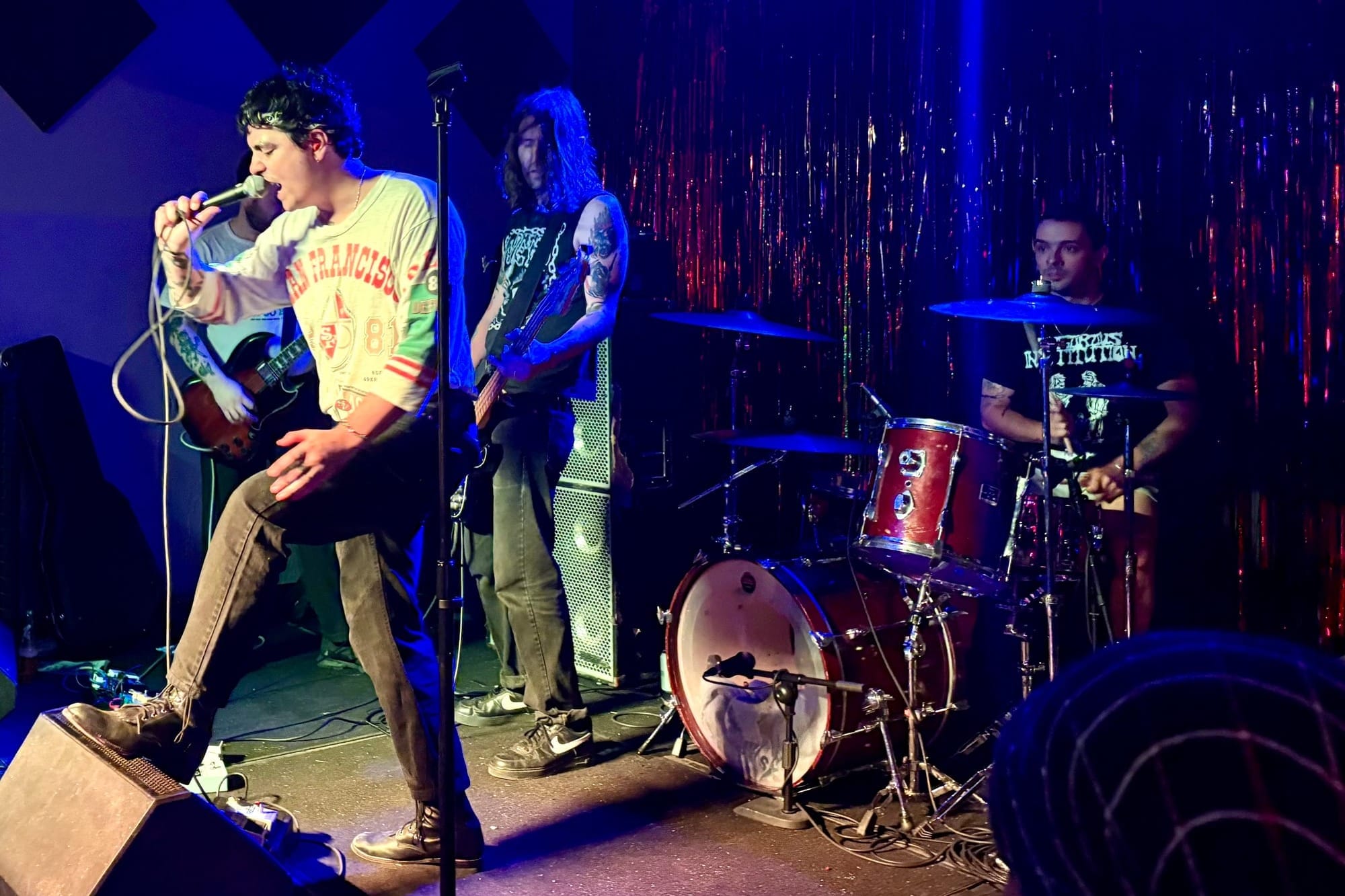
After almost an hour talking with Nick and Smirk’s current touring drummer, Allen Chapman (Poison Ruïn and sometimes Sheer Mag; after a mere two sets playing with Smirk, he assured me: “If there’s any super personal questions, I can answer them”) in the club’s bathroom after their Richmond show, I know a lot more about the band than before. I think the old chestnut about the strangest truths holds. After all, why would it ever be an exception to capital P-R: Punk Rock, or the Extended Smirk Universe? [Pro tip from a bozo: Don’t try recording an interview in a large bathroom with several cavernous stalls.]
My first brush with Smirk was around the first album Feel It Records put out.
Nick Vicario: Yeah, LP. That’s what I call it.
I was at Sam’s when he lived in Richmond, and he started playing me demos for the next record, already. I’d only just heard the band, and was getting into LP, so hearing even more, newer Smirk stuff was a trip.
Nick: So with that record, I enjoyed most of it, but then had a mental breakdown about the songs, and I scrapped it. And so another year went by, then I finally made Material.
I was bracing for another prolific band I’d have to try and keep up with. Right away you seemed to have a wealth of material. Is that just a baked-in benefit of self-recorded one-man bands?
Nick: Definitely, yeah. I can write, self-record, and self-edit every day. That’s what I was doing. It was COVID. I was living at my mom's in Marin, in the North Bay, and she was helping me with that record. A lot of the time she'd be like, “Cut that song. Fix this song.” So she helped me with what finally turned into Material.
Did you set out to be so productive?
Nick: That's not what my goal was. It was just to make obscure Killed by Death sounding records. When I started Smirk, I had no idea about egg punk or anything. Like, literally, I didn't know what that was. I just wanted it to sound like a rare '70s 7”, then people started asking me, “Oh, are you making egg punk?” And I'm like, “I guess. I don’t know.”
Allen Chapman: This is where I step in.
Nick: Please, I would like to hear your side of it.
Allen: I mean, I can say this because I’m a fan of Smirk and a fan of the output. At the time it was like, This is guitar rock that has a post-punk tinge to it, but it’s a little faster. Then I feel like a lot of people were just like, Oh, it’s eggy. But this is really just guitar music, you know?
Nick: Songwriting-ass guitar music. That’s what I was trying to do.
Allen: Exactly. It’s composed,
Nick: And that's what I prided myself on. I started playing punk when I was 12, and I fell in love with rare, weird Killed by Death and Bloodstains punk.
Allen: That shit changed my life.
Nick: Same dude. And that’s what I was trying to do. Then I found the effect that makes it warbly, and it became “egg punk.” I’m like, But no, it’s not.
Allen: It’s like, Oh I have a little bit of chorus on the guitar so now it’s...
Nick: Exactly. Straight up.
Allen: Devo is one of the best bands of all fucking time, and it’s like, Can I not have a little bit of influence without it being fucking classified as egg punk? Can I not be fucking inspired by some shit without it just being immediately pigeonholed into something?
For the record, I don’t think of it as egg punk.
Nick: Thank you. Not that there’s anything wrong with that. I didn’t know when I was writing all those first Smirk records—I was in the North Bay, Sonoma County.
Wine Country.
Nick: Yeah, that's where I grew up. My dad was in Santa Rosa and my mom and I were in Portland during my childhood. Anyway, I was just hanging out with Ross from Ceremony and Bee Wright — who plays in the band now. We'd just meet up, and Ross doesn't know what egg punk is either. And so they would help me, and I thought it was just good songwriting. Punk. But I added that one little fucking tinge, and people were like, Oh my God.
But I don’t wanna make this about egg punk.
Nick: I don’t either. I just wanted to clear my fucking name.
To your point, the writeup for your Richmond show set out to define egg punk as a way of characterizing Smirk’s music and your show here tonight.
Nick: The new record couldn’t be further from that.
And I didn’t want to lump you in with a specific sound so much as these solo DIY projects with a significant amount of output. Maybe because there’s a bank of songs and you don’t have to rely on other people to get it done.
Nick: My band before Smirk started was Public Eye. We were on Iron Lung. It was post-punky. That band broke up, and I just took those songs and did this.
I’m curious about the stretch of time that’s passed between Material and Speculative Fiction, which is such an evocative title for an album. Does it relate to your frustration with genre? Speculative Fiction as a riff on genre?
Nick: Correct.
I think of “speculative fiction”as an annoying term for certain genre writing, like a more pretentious category for sci-fi or fantasy and horror.
Nick: Yeah, but the reason it relates to this record is because half of it is about how when I was in L.A., finishing up living there, I was in a very dark place. I was doing bad, bad stuff, and now I'm married with a kid across the country. And so to me, reflecting on that, those old days, it’s like speculative fiction.
Tell me about your L.A. era.
Nick: It was fucked. I went there to play in Bleached but it didn’t work out. I went there to play in other big bands, but it didn't work out. So I started writing my own shit. So I was like, Mom, I’m gonna go down to L.A. and try to do music for a living. And I did. I formed a band called Cemento.
Allen: Great band.
Nick: And those fools helped me not become a shithead for longer, but eventually it caught up with me, and I was crashing cars and like, trying to rob people and graffiti. So I re-met my ex-girlfriend, who didn't live in L.A.—never lived in L.A.—and we got back together and moved across the country, and I cleaned my life up. I tried L.A. but I couldn’t cut it.
Do you think Smirk’s initial success sped up some of that behavior?
Nick: No. That would've happened anyway. It was me and my psychotic depression and anxiety and trying to make money and shit.
Allen: So the art is existing in spite of the self-destructive lifestyle.
Nick: Yeah, that's a good point. It did help me write some of those early Smirk records. But also, the whole time that was happening, I was living in a house in Highland Park in L.A. with one of the best people I've ever met, one of my greatest friends of all time: Justice Tripp from Trapped Under Ice and Angel Dust. He was trying to guide me away from that bad shit, you know?
Allen: A guy who has changed himself.
Nick: Totally. And at that point he was almost a father figure. But he was in this one room, in the other room was my other good friend named Chris Mathis—Blaque Chris—who ended up passing away. I would say Justice Tripp saved my life. The whole time I was making music with him, and even Chris, was this weird dichotomy. It’s COVID month two, and it was crazy ’cause Justice would come into our room and be like, Hey, let’s work on more of your music. And I’d be like, I’d love to but I have to go to Cha Cha with Chris to DJ all night…
What was your L.A. DJ name?
Nick: I believe it was DJ Sicario [shakes his head]. And then I was like, I need to get the fuck out of here. And I went up to my mom’s in Marin, the Bay Area, and I wrote all those first Smirk albums by myself with influence from Justice. We were definitely bouncing musical ideas off each other all of the time.
And then I fucked up way more in L.A., like, I had to leave basically after that. So I moved across the country, got married, and had a kid. And then while that was happening, I wrote this new record that we're playing now. And so this new record is a reflection of all those crazy ass times. If that makes sense.
Looking back at your time in L.A. as it relates to calling your album Speculative Fiction, does that time period conjure more sci-fi, horror, or fantasy themes for you?
Nick: I was going so incredibly deep on Marvel Comics that I feel like I wasted much of my brain space filling it up with information on that world. It influenced the music in a big way; even to the point where I was lifting phrases and lines from comic book characters.
Which?
Nick: Mostly Chris Claremont’s New Mutants run from the ’80s.
OK so the records come out. You were touring?
Nick: I was grinding.
The reception was positive.
Nick: Yeah.
You were in a dark place, but there was this positive feedback to the music you were making.
Nick: Well I had never experienced positive feedback from my own side with songwriting. Like, I've been playing in bands since I was 12, but I was never the primary songwriter. So when Smirk happened, I was like, Wait, really? You like this shit?
Allen: Art that I made is being responded to by people?
Nick: Yeah, yeah, exactly. So then I was like, I guess I have to tour on this. And we did. We toured quite a bit.
And those opportunities didn’t solve all your problems?
Nick: Correct.
What was riding that wave like?
Nick: It wasn't about success to me. It was just like, Wow, my peers like my shit. I’ve never even experienced that. So that was a big deal, and that's what made me keep doing it. I've been playing in shitty punk bands since I was 12, and it was a part of a scene in Portland where, sure, they booked us on shows, but no one was like, Amazing. Sure, we played with, like, Tragedy sometimes, but I think they just thought we were tight 'cause we were younger. But I didn't really write most of those songs, so I never had that fulfillment until Smirk. And even then, those early records, like, they’re fine. They’re a little goofy. We can admit that. But this record that we’re touring on now, I have never been more proud of the music I’ve written, and it’s really gotten some people listening. It’s crazy to me.
Allen: I'll say this objectively: It’s a great fucking record.
Nick: Thank you. And I believe you ’cause I love your band, and when Ryan [Mangione-Smith of Advertisement] was like, “Maybe Allen will do it,” I was like, “He wouldn’t do that.” And then you did, and now we’ve become very close, and you’re my favorite drummer Smirk’s ever had.
Allen: If I could speak on this for a sec, I think that what Nick is doing with this band and these songs is special, you know? And I think it’s awesome, and I believe in it, and I like to play it a lot. I really like working with him. I mean, he’s also very nice to me, and that makes me very happy.
What was the recording process like?
Nick: Just me with Pro Tools, direct-in guitar, and then...
Allen: Toiling.
Nick: OK. I’m gonna give you the scoop. So since LP one, all of the drums on every Smirk record are stolen from Ringo Starr or, like, the drummer of the E Street Band. I go on YouTube, and…I’m gonna get sued…and I find the drum-only track, because I’m obsessed with how drums sound from pre-’81. So I steal the drums. I go into Pro Tools and map them out. So they sound like old records. So there’s no real drummers on any of the records.
Even with that process, I don’t know how you’d get it to sound so—
Nick: I can tell you if you want.
I think it’s clever and inspired on your part, but will it become easier with AI?
Nick: No, it won’t.
Allen: No, like whatever you did, there’s no fucking way that AI does this. If I could step in for a second. As an example, I know that this is like stepping out of bounds of the aesthetic that we’re talking about, but like, dude, the first two [ed.: redacted] records are Beach Boys drums.
Nick: They literally took Beach Boys drums?
Allen: Literally that. Those records are samples of drums.
Nick: Damn it. They beat me.
Allen: But your drums, I will say that’s an inspired thing.
Nick: No, I would argue that is literally what I do. I go on YouTube, I search: “Here Comes the Sun isolated drums.” I find them. I put them into Pro Tools. Chop them up. So literally every Smirk recording is either Ringo Starr or the guy from Queen’s drums. Like, there's no real drums on any of my records. It's all stolen from the ’70s and ’60s. Do you know the song “Crime Pays” by Smirk? Maybe you'll recognize the drum sound at the beginning.
Allen: I mean, I will say as the dude who’s playing drums in this band—it’s Ringo. And Nick being like, Oh, it’s just literally the thing that Ringo does. I was like, OK, I understand you, son.
Nick: Are you familiar with the Smirk’s song “Do You?”
Allen: Which one's that?
Nick: It’s like: Dun, dun, dun, dun, dun, dun, dun, dun, dun. On the first record. Dun, dun, dun, dun, dun. Yeah. OK, check this out. Those drums are literally “Here Comes the Sun” by the Beatles, sped up. So it’s a cover.
Everything sounds consistent. Is that a mastering thing?
Nick: Consistent how?
The drums, song to song to song sound of a piece. It’s not a hodgepodge.
Nick: Oh, do you know why? Because on my hard drive I have Ringo Starr songs, the drums only, and it is consistent 'cause I’ll be like, Hmm, which Ringo Starr beat do I wanna use today? Literally, that's why.
Allen: I will also say, you know why it's consistent? He mixed a ton of this record and completely, utterly, crushed it on the fucking mixes. And it has an aesthetic flow and quality to it that I think is obviously felt and a part of the thing that makes the record so powerful.
Nick: Thank you.
Allen: I think that you're maybe picking up on that. You know, that it's like there's an intention to the way that the songs are mixed that I think you really feel.
It sounds like an album.
Allen: It does. It has a flow and a feel to it.
Nick: OK, well then that’s true because I went to school for Pro Tools and manipulating shit, but also from 2010 ‘til 2018, I played in a synth indie pop band—not punk at all—and I wrote for it. I produced it. It was called Wild Ones. That’s where I learned how to manipulate all this shit. I grew up in punk, and then I was like, Fuck this. Then we did Wild Ones, and that was that.
What’s the Poison Ruïn/Smirk connection?
Allen: Me. I'm the Poison Ruïn drummer, and I’ve been playing drums in Smirk.
Nick: I feel like we've gotten very close. I wanna write music with this fool.
Allen: Same.
The new Poison Ruïn—
Nick: It’s incredible.
That and your new record feel good together.
Nick: Their record influenced Speculative Fiction, like hella. I told you that when we first hung out.
Allen: You did. I protect myself in a way that I never feel like anybody cares about anything that I do.
Nick: Same.
Allen: And I lived my life in a way that it’s this shield that I put up.
Nick: Straight up.
Allen: To help myself from the eventual failure. But meeting somebody like Nick? We started playing together, and I feel very connected to you.
Nick: Likewise.
Allen: I think Speculative Fiction is an example of this in a super massive way, that there's something that he's doing that is super special. I’m really happy to be a part of it. It's a triumph. And I'm saying that as a guy that had nothing to do with this, that I'm just playing in now. I feel like I've got a look at you from that record that feels really intimate and personal, and really ambitious in its songwriting. I think it succeeded massively, and to be involved in it in any way just brings me joy.
Nick: Oh, thank you.
Allen: It makes me happy.
Nick: No seriously, that means a lot to me.
Bigger picture, are you feeling settled in Connecticut?
Nick: I moved to Florida five days ago.
see/saw is a reader-supported publication. If you enjoyed this article, please share it and subscribe!