shaved ape on the punk mentors who changed his life
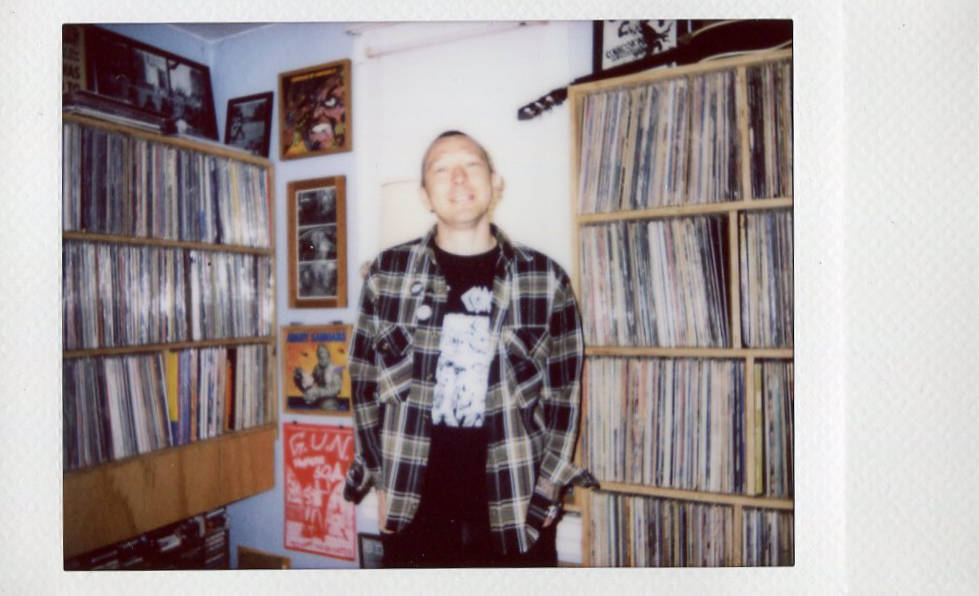
In a dining room lined with decades of punk ephemera, Vince Klopfenstein shares stories about chance encounters and the beauty of hardcore.
Clocking in at less than 11 minutes long, Loveletter to Hardcore is a spirited collection of songs recorded in a basement in Braddock, PA on a 4-Track recorder that radiates the infectious joy of hardcore punk. Its blistering speed and youthful energy are amplified by the cover image—a young Riky Barnes soaring midair on a skateboard with a huge grin on his face. The Sorry State-released vinyl’s A-side is newer material from Shaved Ape while the B-side is the previously released demo. There’s something charming about the dip in audio quality in the back half, as if the listener is digging further back into the older 7-inches during a nostalgic night with a turntable. It’s the sound of skate videos, sweaty VFWs and basements, an image of sweaty freaks pumping their studded cuffs in a blurry fury.
While it does effuse a youthful joie de vivre, Shaved Ape is the solo project of a veteran punk, Vince Klopfenstein. As a drummer and guitarist Vince has been a part of the bands Sickoids, Loose Nukes, Kim Phuc, White Stains, and G.U.N., to name a few from his repertoire. Klopfenstein spent his teen years outside of Normal, Illinois, and has lived in Philadelphia, Los Angeles, and for the last decade, Pittsburgh. All the while, he’s been making and enjoying hardcore punk. His house is full of fliers, show posters, and an impressive collection of records. When he’s not rocking, he’s working as a carpenter doing gigs like building CD storage for local record stores.
Shaved Ape was never supposed to be a live band. In 2022, it was just a fun excuse for Vince to mess around with a four-track at home. But when Sorry State was celebrating its 10 year anniversary, they requested a live Shaved Ape performance, and his friends in Raleigh and Charlotte had already learned the songs without him even asking. What choice did he have? He stepped out from behind the drums and took the mic.
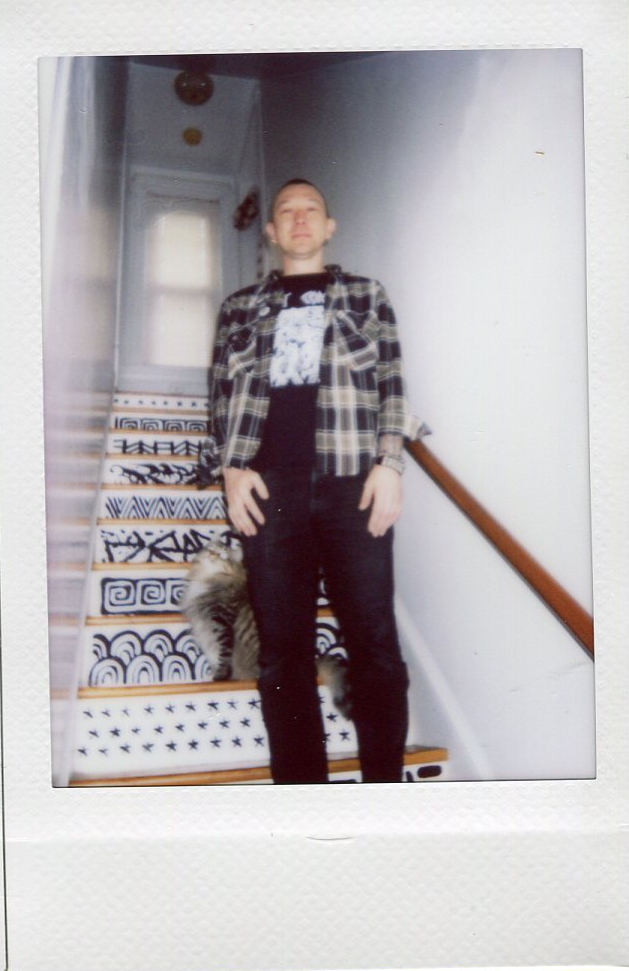
Vince and his partner’s house sits on a sleepy hillside in the rust belt suburb of Braddock, Pennsylvania—a storied base for many Pittsburgh hardcore punk musicians over the years. We spent a quiet Saturday morning talking about punk origin stories, the magic of intergenerational knowledge sharing, and what’s exciting to him right now.
As a drummer you’re used to being in the back. When you were recording these songs, did you ever imagine having to actually front the band?
That’s kind of what I’d been doing before for the last however many years—like almost 20 years of being in the back and sort of protected and just locked in. I do kind of prefer that. And there was a moment when I thought, Well, if we did this live, I would play drums, but then I was kind of like, Who would sing? I’m not really sure. So I just decided to do that. But it’s pretty much the opposite dynamic from drums to singing.
So I still don’t think that I’m a frontperson. Just like when you see a singer who’s born to be a singer or a frontperson and they’re just killing it and full of energy and bouncing all around, I don’t have that. I can do it, and I can get up and scream into the microphone, but it’s a little bit different. But it hasn’t completely deterred me from giving it a shot.
I think there’s no actual human cardiovascular way that you could do the vocals and the drums for these songs at the same time.
At this point, no. Actually, I played guitar first when I was in high school. I didn’t pick up the drums until about 16 or 17 or so. And I basically was like thrown into the position of trying to sing and drum at the same time. And it was really hard, especially when you suck at the instrument, just adding another thing. Because I could play guitar and sing—sort of, very badly—but I could get through it. But drumming and singing? I basically gave up on that a long time ago. It’s brutal. And some people can do it and it’s amazing.
Are you thinking about performing when you’re up there? Or just getting through it?
When I first started to do Shaved Ape live, within five seconds of singing, I literally was almost ready to pass out. Like I would feel like flush and then be like, OK, get it together. It was like a seconds-long sort of reaction. It was all this buildup and then just like screaming as loud as I can, pushing all the air out of my lungs, and I would be lightheaded. And I don’t know, I’m diabetic as well. I don’t know if that was because my blood sugar was all fucked up. But yeah, just doing that on its own can be brutal because I’m not very good at it. And managing to say all the words? I think I was more focused on that and remembering the words too.
Doing it as a band where it starts organically, you practice for like a year or something, and every time, you get tighter. When it was just a basement project, I wrote the lyrics down right before it was time to record it, blast it out, and then not really have to think about it again for another year or something, or even at all. Until I had to. And I was like, Oh shit, I have to know these songs. With some of them, trying to fit the words to the music...I was probably a little ambitious with how many words. There’s definitely a way to do it where you could have very few words and it’s super powerful. Sometimes too many words is just not the vibe.
Punk is a spectrum. On one end is Crass and Youth of Today, and the other end is…
Like Discharge with a haiku over a minute and a half or something. Or powerviolence bands like Crossed Out or something—literally a six-word sentence, that’s the lyrics. Mine’s probably somewhere in the middle.
How did Shaved Ape start?
At the time that I was kind of messing around with riffs and stuff. I was in White Stains and Loose Nukes at the same time, which is almost the same band, just different singers. I would record riffs to just be like, Oh, that’s a cool idea. I’ll record it on my phone on this like crappy recording app. And then I had this sinking feeling that my phone was just gonna die sometime soon or break and then nothing was backed up. And I was like, I should actually pick through this collection of bullshit and see if I can make songs out of this. So around the time that those bands broke up, I was like, This is a way to kind of focus some energy on that before my phone explodes and all of it would be forgotten. I’m the kind of person where if I don’t record it...
It’s gone.
I’ll forget it. Eric [Montanez, bandmate] is the same way. Like I know a lot of people that it’s just like, wait, what did I just play like two seconds ago? I don’t remember.
Being like, “Oh, I love that riff that you played.”
And they’re like, “What riff?” So that was like pretty much how that started. I’ve always messed around with four tracks and recording, and I had been using it to record some of those bands’ stuff, which was also a little ambitious because it’s a little different doing it one instrument at a time to get it to sound like clear and still kind of shitty. But in a live room, it’s just hoping that everything’s gonna bleed together in the right way. So I already had been messing around with that for a long time and then decided, Fuck it, I’ll just try to record these songs for myself.
How did the artwork come to be—the Chuck Hults photo of Riky Barnes?
When I saw that photo, it was like, this is the vibe. It’s like pure joy. And it’s like punk and skateboarding, like fully on display. So I was really stoked when the photographer agreed to have it be used. And obviously Riky Barnes, who’s in the picture, I’m not sure if we really would have needed his approval necessarily, but it sounded like they were both psyched to use it. At least hopefully they were.
How did you get in touch with Chuck Hults?
I hit up Daniel [from Sorry State] who said, “Oh, we know someone who works at Thrasher and we have a pretty good relationship. They know these people and would be happy to reach out.” And then through this other person at Thrasher, they got in touch and then talked it out and worked it out from there.
It’s so cool how intricately woven the history of punk and skateboarding is.
For sure. And it’s kind of probably since around the time that I did the first tape that I started really skating on the regular again and hadn’t really skated since I was a teenager. I was never good. I’m better now at 44 than I ever was at like 17 or 18.
That’s awesome.
Which is still not good, to be clear. I got my pads on and I’m just barely making it through and falling a lot. But it’s been super fun. And so I don’t know, maybe it was like finding that photo that got me amped up even more.
How did you get into punk?
I was like middle school obsessed with Nirvana in the ’90s, I learned all the songs on guitar. Like grunge fully hit the Midwest. I grew up in central Illinois where we would get everything like 10 years late, even though Chicago’s like 2 1/2 hours away. I got a book about Nirvana [Come As You Are by Michael Azerrad], so I’m looking through this book and they’re talking about Black Flag and Bad Brains and Minor Threat and Flipper, and like Kurt Cobain would wear a Flipper t-shirt or like the Feederz sticker on his guitar. And so that kind of got me interested. Like I knew about the Ramones and the Sex Pistols, but everything beyond that was pretty foreign to me.
And so in Normal, Illinois, which was 20 minutes or so from where I grew up, there was a head shop and record store. Mother Murphy’s is what it was called. It was one of the oldest head shops in the country. It’s kind of this amazing, special place. It still exists. They don’t have many records anymore, but my parents would take me when I was like four and five. My dad would go there and buy like Bob Marley records and buy rolling papers and shit. You go up the steps, it’s on the second floor. And it was just like, you were like climbing into this crazy space, like, paint, artwork everywhere. As soon as you open the door, music’s blasting and it’s just like overwhelming. It’s called the rock’n’roll emporium or whatever. And there’s a sign of Jimi Hendrix and Chuck Berry where they cut it out of plywood.
I went in there and was like, they’re like, “What are you looking for?” “Black Flag.” So they’re like, “Take this, do you want a CD or a record?” And my dad had a record player. I didn’t think I had a record player yet, so I got Jealous Again by Black Flag on CD. And that was kind of the beginning. I was hooked from there.
That’s awesome. Also like crazy to have that sort of magical portal near where you grew up.
It was amazing that existed because I think honestly without it, my life could have been completely different. And the other funny thing about, well there’s many cool things about that store but I would always see this record. There’s just a black cover with a naked person with like nuns in the background, like looking like shocked. And it says “Naked Hippy.” And even as far back as being like a child, I would see that in that store. And it wasn’t until I was getting into punk that I realized like the guy who manages the store—that’s his band from the ’80s. And it’s like one of the best fucking records ever made. It was kind of second wave. It was late ’80s. So like the whole like ’81 to ’86 or whatever happened. And then these guys started that band sort of after that.
At that point the internet existed, but like I couldn’t imagine you would find that record on the internet at that time. So it was still a lot of trading tapes, word of mouth. I also would order records from Sound Idea and he had, this was like a record store in Florida. And on the back of the Slug and Lettuce zine, I don’t know if you ever saw those, because they haven’t really printed any in quite a while. The entire back would be like a mail order form, like probably a list like 1000 in tiny print. You could just go through and order and call the phone number.
And so when I was like 17, living at home, going to high school, I would call the number I’d have my money—like however much I was making working for my dad set aside, but then my mom would have to get on the phone with the credit card and read the number. Or I would read the number and then the guy, this dude, Bob Suren, he was like, “Well, you’re going to have to put your mom on the phone. It’s just we have to do it. We trust you, but…” and I was like mortified. So my mom gets on and she’s talking to this dude at a punk record store in Florida. And then they get off the phone and he’s like, “All right, it’ll be there in two weeks or whatever.” And so fast forward to when I’m in school, I’m in my own apartment. I get a random call from this guy, Howie, who had gotten my number from that record store.
From Sound Idea in Florida?
Yeah, he was good friends with Bob. And this guy asks Bob like, “Do you know anybody in Normal, Illinois?” And he’s like, “Well, there’s this one guy that’s ordered from me, like, try him.” And then he just called me out of the blue. And he’s like, “Hey, dude, like, I heard you like punk shit, I just moved to town from Louisiana and you should come over and listen to records.” So I just immediately became friends with this dude, Howie Burkenstock. He sang for a Reason of Insanity and had been in bands for a long time, but he had an amazing record collection. I think all he moved was like his dog and his records and some clothes.
And that was another thing where if that hadn’t happened, I don’t know, like I would have maybe eventually heard a lot of stuff, but hanging out with Howie was just like a torrent of amazing music just coming at me, and pretty much none of it had I really heard or encountered.
You’ve had so many random ass punk gurus, that feels so lucky.
I’m super lucky that some of those happened. And the dudes at Mother Murphy’s were. It was funny because there was a pretty heavy garage punk scene there. Like you’d hear Teengenerate blasting and I would just be blown away. I have to get that. And they would book shows at this dump of a dive like right down the street. And they managed to get like amazing garage bands, like the Oblivians, Country Teasers, like that network of garage stuff. And so they would kind of tease us like young kids. Like they’re like, “Oh, you don’t know 7 Seconds? Get that record, dumbass.” And like called me by the wrong name on purpose. There was this dude, another old head from there that knew all this shit and would sort of begrudgingly tell us about stuff. And it was all these random moments like that you’re like, Oh shit, that was pretty significant.
This record is such a joyful collection of songs, and there is this youthful energy to it. Hardcore punk is in a lot of ways supposed to be like a young person’s game, a youth genre. So how do you balance that? How do you feel about the general state of hardcore in that way?
Yeah, I definitely agree that it should be and has always been a youth culture, like an explosion of youthful energy. So when you hit middle age and you’re like, What am I doing here? There’s a way to sort of be like, I’m gonna stay young till I die, like refusing to become an old person and refusing to age, and you just stay locked in the same mentality that you had when you were 17, which I don’t think is always very healthy.
I don’t think that 50 year olds in punk should necessarily be gatekeeping everything. Definitely some things are important to make sure everyone’s aware, like there’s a good way to be, but if you’re policing 20 year olds, I don’t know that that’s the way to do it. I never want to be like in my mid-40s telling a 20 year old what to do. If they’re really fucking up bad, then yeah, definitely.
But like the torch is going to get passed. And if kids want to do some crazy, interesting, different shit and if they want to be in a band and not check all the boxes that you think need to be checked, that’s fucking fine. Like, they’re gonna figure it out. And it’s kind of like, if they fail, that’s fine. I think it should always stay with the youth, as sloppy as it will be. It’s been funny to be on tour, at shows or playing shows like a bunch of people in their 40s or late 30s trying to keep rocking out. And it’s like, I do sometimes wonder like, is that, is this the move? Or is it time to put that behind me? I feel like there is a way to do it without being like, “OK, grandpa, let’s get you to bed.” There’s a way to do it where you’re involved, you’re doing your thing, but you’re not trying to control anything. And definitely not like trying to overly influence what young people are doing.
What punk shit is exciting to you right now?
Well going out on tour in 2024, we got to play with some bands in the Norfolk area and Virginia Beach. I think the sort of Richmond, Virginia Beach, Norfolk scene is very youthful—very out of control and exciting. That was really awesome to see and inspirational. Unlawful Assembly in Milwaukee. I got to see Brainwash Victims recently, who are fucking amazing, but I just really like what that label is doing. All the releases are very carefully done, like very well executed. And the bands are all, you know...they all rip.
see/saw is a reader-supported independent punk newsletter. If you enjoyed this piece, please share and subscribe.