shop talk’s secret? they don’t have anything to prove.
The Brooklyn garage punks sit down at a local bar to discuss slugs, Ramones, and approaching the band without ego.
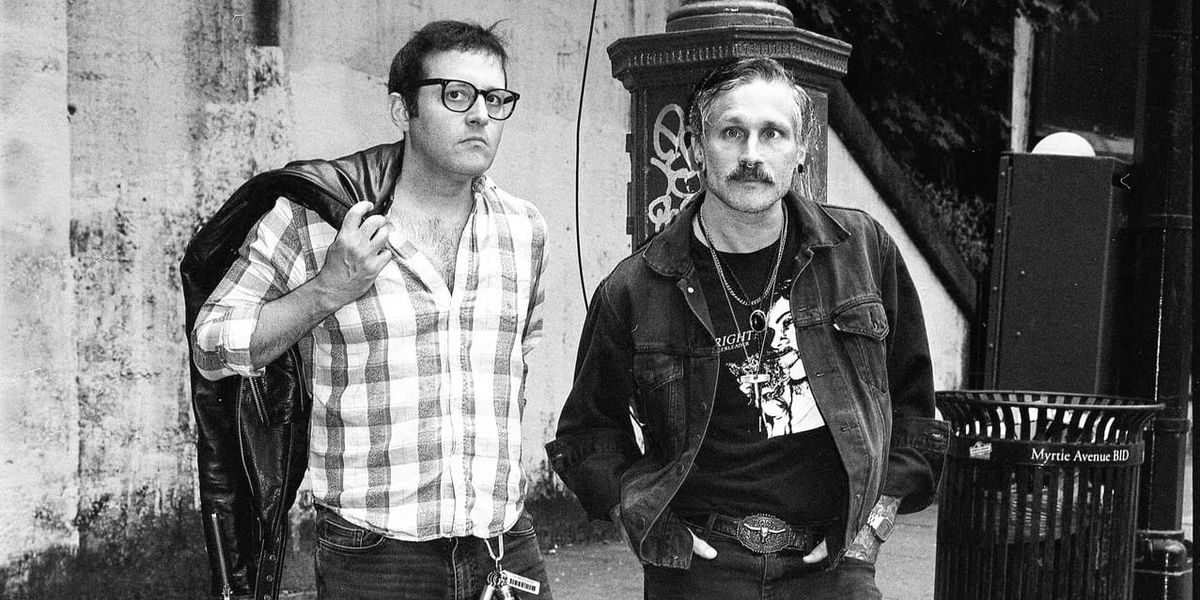
Jon Garcia and Tristan Griffin of Brooklyn’s Shop Talk enter a bar like they enter a song—headlong, without hesitation, and in unison. Shop Talk’s music is fast, not speed metal fast (thank god), but fast like Rat Fink’s infernal racer—blurred wheels, scorched eyelids, exhaust pipes spurting flames. They’re songs for shoving your neck out of car windows. Shop Talk’s first full-length came out in March, and it’s a 30-minute crash course in everything that rules about punk rock. There’s the Pretenders’ melodies, thundering hooks that Ty Segall could envy, and the Clash’s fucking sneer. But all this through a viewpoint, sound, and style that is undeniable and uniquely their own.
Jon and Tristan both have backgrounds in literature, as is apparent in the razor wire wit and jet-black humor of Jon’s lyrics, and this literary approach gives the band an ability to craft tunes that broadcast from an alien space. It is the history of punk rock from another planet crashing into you at 10,000 miles per hour, so it’s in pure form when the moment I sit down at the Bedstuy bar where we’re set to meet, four legs four arms and two heads fly through the door. There’s a flurry of handshakes and a barrage of smiles and laughter, and immediately we’re cool. We’re moving. We’re grabbing a table in the back. The instant we sit down, as Jon checks his phone before turning it off.
Jon Garcia: Alexander [Perrelli] who played on the album just texted us saying he listened to the record for the first time today. Like this moment he’s like “thank you so much for making this happen, that’s all I can say right now.”
Tristan Griffin: That’s amazing.
You just got that text?
Jon: I swear to god, seconds ago.
That’s beautiful.
Jon: Isn’t that nice? It may be fated.
How did you find Alexander?
Jon: I’ve been doing Shop Talk for a frighteningly long time, butvery much under the radar. Alexander was actually involved before Tristan, I want to say 10 years ago give or take? It was kind of my recording project. I had been playing in a band that broke up and I started writing all these songs and I kind of wanted to front a project and was figuring out what I was doing slowly and learning as I went. But Alexander was actually the first person I played with all those years ago. In the beginning it was just me and him. I made some demos where I played guitar and bass and stuff.
Tristan: I started playing with you at least four years ago, when he was still involved. Eventually you know, [Alexander] is married and he’s a visual artist, and he wanted to get back into visual art. And you know we’re not young men any longer [laughs], we’re all touching the 40s, and he’s focusing on his visual art right now.
Jon: Tristan’s actually our third bass player, and we’d been doing this kind of in obscurity, and by the time Tristan got involved we had this huge backlog of songs. There are songs on the record that are like nine or 10 years old. I had been sitting on this stuff and hadn’t found the right opportunity to put it down, or like hadn’t found the right collaborators. But then I met Tristan at TV Eye. It was right after COVID, the city was starting to reopen, people were back at work, people were going into bars again, people were starting to take their masks off. It was that moment. And we met through some mutual friends at TV Eye and had one of those drunk 3 a.m. conversations like, “We should play music together!” and bizarrely wound up doing it.
Tristan: I had been going to TV Eye probably since it opened because we had mutual friends who ran the place. I was living right over there at the time, so I was going over to TV Eye a bunch and me and Jon started getting to know each other. And every time I came in it would be big hugs, and we would start hanging out.
Jon: We would talk shit about music, we just got on right away.
Tristan: We started being really good friends and every time I walked through the door it would be like “Ayyy!” and the conversation would progress and progress and progress.
Jon: Jeff Berner [bassist for Psychic TV and bassist of Shop Talk at the time] had a young daughter, and COVID had changed things. We weren’t playing gigs at that point. And things started to reopen, and me and Alexander wanted to play and [Jeff] said, “Look, my daughter is too young to get vaccinated, so I can’t really play shows for a while.” So it was around that time, we’d been offered a couple of shows I really wanted to do, and again, fate conspired…
Tristan: Which it often does.
Jon: Tristan rolled into TV Eye and then we started bullshitting and I was like, “What are you doing on the 23rd? Do this fucking show at Saint Vitus. Do you want to learn some songs real quick?”
Did you know about Shop Talk before that?
Tristan: No, never heard of it.
Jon: No one knew about Shop Talk! I could count on my hands the people who knew about Shop Talk.
Tristan: A lot of the stuff on this album Jon had written before I was even involved, and so when he sent me stuff I was like, “Hey, look, I like where you’re coming from, I like the songs you’re writing, it works with what I’m doing and what I like.” So we jelled immediately.
Jon: There was a sense of it being my project, and I had some talented friends who were willing to play with me when our schedules allowed. And when Tristan got involved, it changed. It really became more collaborative, and also there was the sense that it wasn’t just one guy pushing the boulder up a hill or something. He was in it, like, “I want to tour, I want to make records, let’s do this!” And obviously I’d been wanting to do that the whole time, I just hadn’t been in a position where that felt possible, you know?
Tristan: Yeah.
Jon: And when we decided to actually do this, like, “Let’s do this band,” it started to come together really quickly. We put out an EP, went on tour with Algiers, who were friends of Tristan’s and became really close friends of mine, too. And we just started to double down on this.
I want to talk about your song “Love Dart.” This is wild, but “love dart” has been my password since college.
Jon: Woah, crazy.
I’m an insect guy.
Jon: Yes, slugs!
Is that what it is?
Jon: Yes and no. I’m aware of slugs…
Tristan: I too have seen a slug.
Jon: I’m aware of slugs having love darts [author’s note: go research love darts and slug sex], and I think it’s a humorous title. But the jumping off point for that one is this James Joyce short story called “An Encounter.” There’s a scene in that that was the jumping off point for the song: these two young boys skip school, and they’re in a park, and they come across this kind of creepy old man who’s like giving them a lot of unsolicited advice about love and relationships. The story is written from the perspective of one of these kids, so the narrator doesn’t necessarily understand what’s happening all the time.
At one point this old man is probably masturbating in the bushes, he’s not necessarily a role model or a trustworthy advisor, but he has no problem giving them a lot of advice about relationships and about love, and they’re kind of creeped out and they don’t know what to do. It’s this darkly comedic scene. And at one point he says, “Every boy needs a sweetheart,” which made its way into the song. So I’m imagining this monstrous fucked up old man telling some little kids what’s what, that’s kind of the tone of the song for me.
And the title “Love Dart” came after everything was finished. So yeah, slugs, but to me that kind of underscores the idea of the song. Love is inherently violating, in a way. It’s not something that starts internally. It’s not a choice. It’s something you fall into. Or if you take the mythology surrounding cupid—which, by the way, is pretty weird—you get darted. Something a veterinarian does to an ape. You get darted. You fall in love. It’s something that external forces do to you. And it doesn’t always go so well. And this old man, monstrous as he is and untrustworthy as he is, isn’t necessarily wrong when he’s telling these kids to be careful, to be careful with your hearts.
Are those the kinds of songs you’re drawn to—the cautionary tale?
Tristan: I feel like half of all love songs are cautionary tales.
Jon: That’s true. That’s very true.
Tristan: And I love love songs. If you look at it in the right light almost everything’s a love song.
Jon: I think I can name one song of ours that isn’t a love song. And it makes me worry a little bit, that I need to move on, or maybe this sort of character needs to be retired.
Tristan: I disagree! Literally everything if you look at it the right way is a love song. Literally everything.
Jon: Yes! Yes yes yes. It doesn’t have to be amorous…
Tristan: Not romantic love, but everything’s a love song. What are we if we’re not fucking love? Doing our best to fucking find any version of that that we can? Whether it be love, whether it be stability, whether it be something that speaks to you.
Jon: You make a good point about a cautionary tale. “Mirage of Love” is not exactly a cautionary tale, but it has “love” in the title.
Tristan: That’s a good link. [laughs]
Jon: I mean, I think that is a song that is to some extent tied to the Ramones song “53rd & 3rd,” so it’s a bit of a New York thing. Like the La Fata Morgana, the sorceress who lures sailors to their death by seducing them with false visions and things. So the song is really about this character who is mad that he hasn’t been picked, in the way Dee Dee was, like in their song: “trying to turn a trick, you're the one they never pick,” and then he murders the guy who picks him. And clearly he’s very conflicted, he doesn’t want to be picked but also he’s mad he hasn’t been picked. In “Mirage of Love,” the character understands that being seduced by Morgana means him dying for something false, but he’s offended that she hasn’t bothered to try to seduce him. That’s what the song is about, which is a very Dee Dee concept.
Tristan: That was some of our first experiences writing together. Not the lyrics, Jon writes all the lyrics, but musically. Our writing process together is very good actually. A lot of time in a room being like, “do you have an inroad to this, do you have an inroad to this? Do you want to work on this?” Taking it away, bringing it back, hours and hours of back and forth.
Jon: For a long time, I would just present finished things to whoever was willing to play gigs with me. When Tristan got involved, it became more about cycling through ideas, kicking it around together. It became less lonely.
Tristan: We very quickly established a trust together, musically, through songwriting, and just in general, as people. We love each other. We are able to bring stuff in and work together without having this ego about it or being precious about it.
Jon: Really, I think that this is rare. I think this is actually honestly precious and not normal? I think there is a level of trust between us that when we’re collaborating on something, we’re really just trying to make it as good as we can make it. It’s not about ego. It’s not like “this is the best idea because it’s mine,” it’s like we’re just trying to make it great. We’re fairly honest about being in pursuit of that.
Is that because this band is happening now at a point in your lives where you’re ready, or is it happening because it’s you both?
Tristan: Maybe it’s because we’re older and maybe we don’t have that ego and need to be like, “This is mine, this is me proving myself.”
Jon: Right.
Tristan: We’ve proved ourselves in different parts of our lives. We have enough self-awareness, and we each have enough sense of self, from being older.
Jon: I think it’s because we have fairly similar tastes.
Tristan: And the flip side of that is I think it’s because it’s us. We do have a lot of the same tastes, we have a lot of the same standards of what makes something great. We see eye to eye on a lot of stuff. And there’s a certain chemistry even interpersonally that translates to the music. I think it’s both. Maybe when we were younger we might have butted heads more because young people have something to prove. I’m too old to have something to fucking prove, dude.
Jon: One hundred percent.
Tristan: Rather than proving something, I’d rather be in a band that I’m happy with—with a person I like working with, striving after something great—rather than striving after trying to be the guy.
see/saw is a reader-supported publication. If you enjoyed this interview, please share and subscribe.