bullseye won’t do the same thing twice
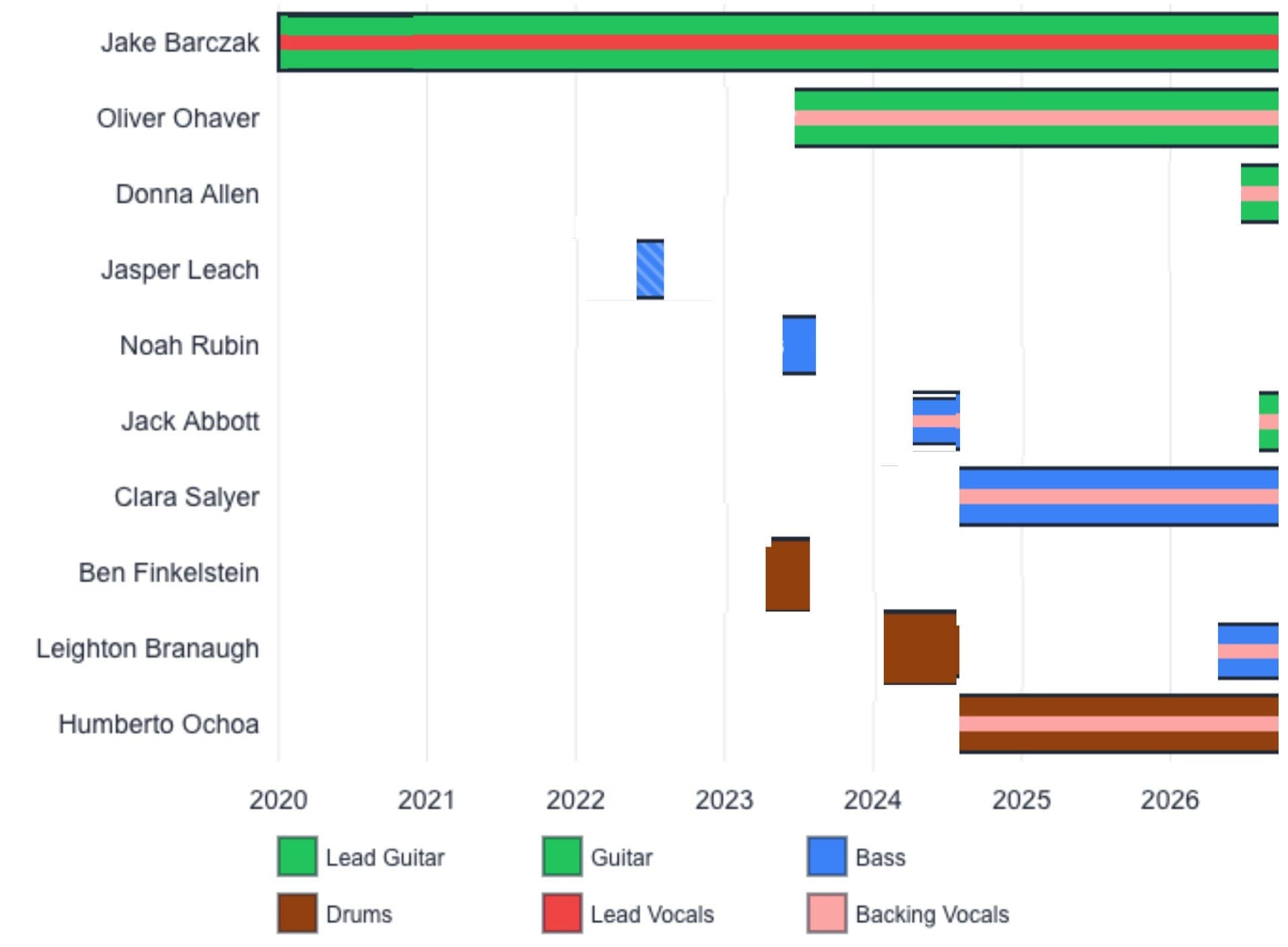
The NYC band has a rotating lineup, songs that don’t sound the same way from show to show, and a great new 12" on ever/never. And a Wiki-style members timeline chart.
Bullseye taps into a type of guitar rock that no one really makes anymore. It’s easy to get too bogged down by nostalgia making this music, but Jake Barczak has somehow cracked the code for the modern age. Since 2020, the catalog of songs he’s developed for Bullseye are catchy yet well-crafted, personal yet universal, and most importantly, fresh. They’ve been called every sort of genre from slacker rock to jangle pop, but whatever it is they have, it comes from that great Midwestern guitar muse that Barczak must have been blessed by somewhere in his youth.
Barczak hasn’t lived in Minnesota for years, and in other ways, Bullseye is uniquely at home in New York City. They’re a DIY band through and through, playing the basement shows and the shit bar circuits that weed out the weak. Barczak leads a band of consistent members, but the occasional rotation brings out some of the scene’s best musicians. Bullseye’s self-titled tape came out in 2024, and this year, some of those songs received new recordings on their first vinyl release with ever/never. Also self-titled, the 12” EP’s tight six songs are a revelation on wax, the true result of what hard work does for a sound.
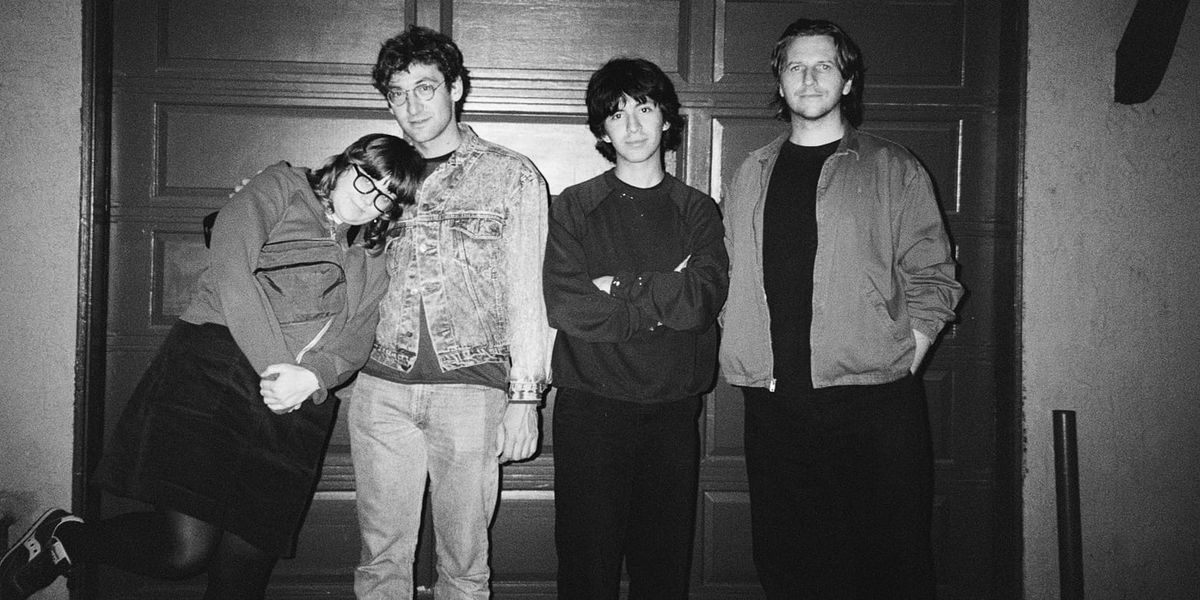
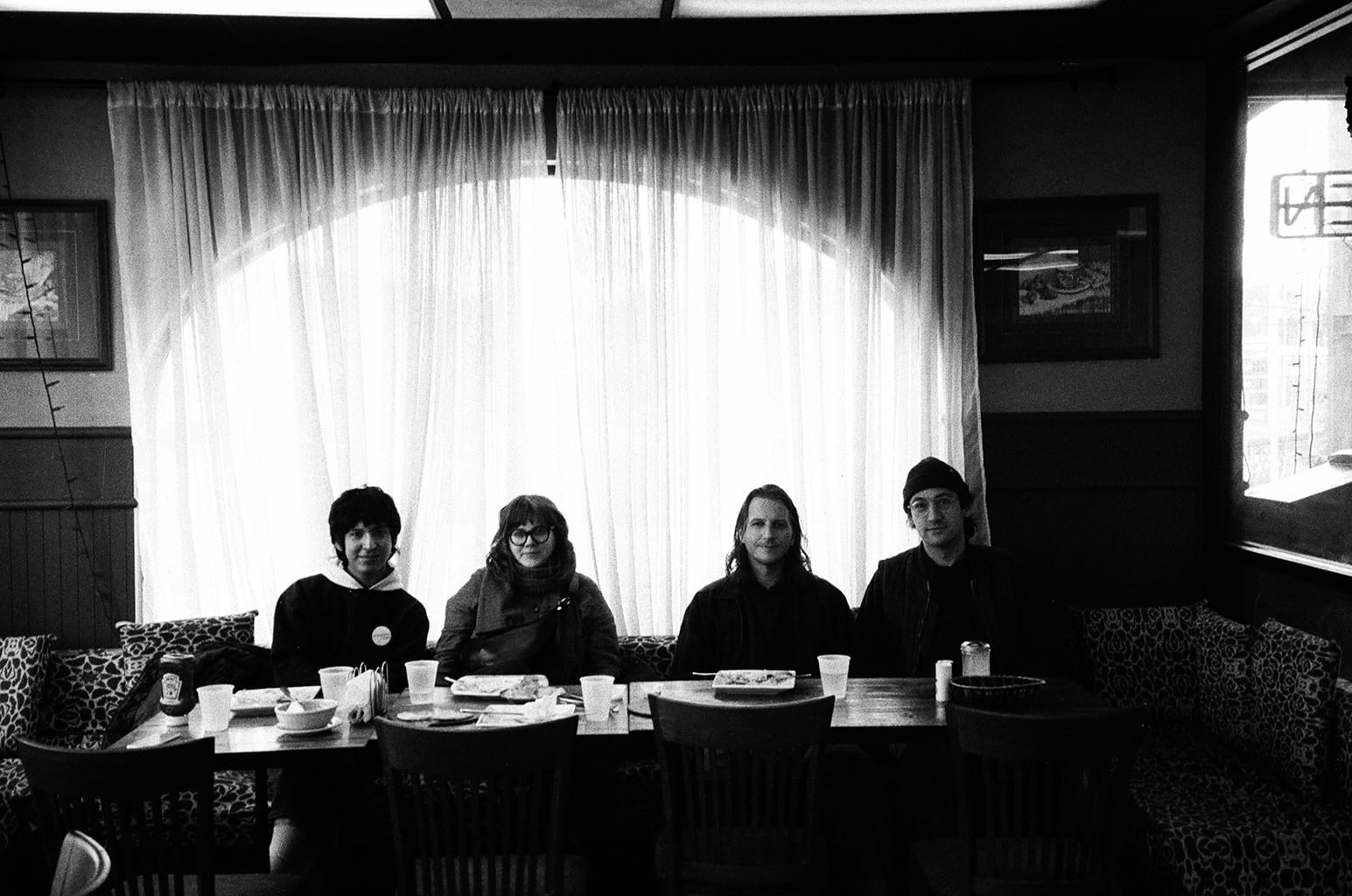
After taking a bus to the completely wrong intersection in Queens, I found Barczak and guitarist Oliver O’Haver at a sunny plaza in Ridgewood. They said it was a place they liked to hang out—right next to the street traffic but surrounded by foliage and quaint shops. We watched the local bodega cat attempt to climb a tree as drummer (and graphic designer) Humberto Ochoa arrived. Bassist Clara Salyer couldn’t make it, but she sent her love. And as we dragged together a few cafe chairs (that were chained to the ground), the band’s story unfolded.
When did you start making music in New York?
Jake: I moved here from Oakland in 2019 with a band called Patty that I played in. That was a post-punk project of sorts. We played here for a handful of years, and then it dissolved and Bullseye started. The songs started with me just writing on my own and finding a way to write rock songs that felt good. Like so many others, it was a deep Guided by Voices dive that began some of those songs.
And it was also like so many others during the COVID-19 lockdown. I sat on those songs for a long time and self-recorded a lot of them. It wasn't until three years ago that I had some friends prompt me to make it into a band for a show, and then it built from there. There's been a lot of different people in the band over the years, but Oliver's been here the whole time.
Humberto: Maybe you should go through the different iterations of the band.
Jake: Okay, so the first one was Oliver and some folks I used to work with, Ben and Noah. Noah, honestly, I have to give him credit for making me book a show. We played with Oliver's other band, Burner Hertzog, at the famous Gold Sounds bar and lounge...discotheque, whatever.
Where we all start.
Jake: Exactly. At that time, we were called Red Gas Circle for one show. I then played in another band with Leighton [Branaugh of Guyscrapers] called Act, and then Leighton played our drums. Then there was a tour I booked in 2024 in the summer where Leighton was in it, Oliver was in it, and then I got Jack Abbott [of Answering Machines] to come from Chicago and play a tour through some of the Midwest and the South. We were called Bullseye at that point.
Oliver: Our first show was with another band called “Bullzeye” with a “z.” And I thought we were that Bullseye 'cause we had never had a flyer, and Jake asked, “Should it be with an ‘s’ or a ‘z’?”
Jake: I guess they forced our hand to make it normal Bullseye. And then Jack went back to Chicago. I asked my old friend from Minneapolis, Clara Salyer, to play bass.
Humberto: I got involved through Leighton.
Jake: And then the lineup here has pretty much been Humberto, Oliver, me, and Clara. But then with a bunch of variations too. We just did a tour through the Midwest to Minneapolis where Donna Allen [of Chronophage] played her solo music opening up for us and then played guitar for half of the tour as well. And then this summer it'll be me, Jack again, Humberto, and Leighton. So yet another iteration.
Oliver: I saw Bullseye without me in it in Pennsylvania, and it was really cool. It was like an out-of-body experience.
Jake: Yeah, you were tripping.
Oliver: I joined for the last two songs of that set, but I kinda wish I just saw the whole set without playing. I wish there was a version where all of us played.
Jake: There should be; that would be fun. We made a very convenient chart to clock all the different members.
Oliver: Like a Wikipedia timeline. I wanted to make shirts of it but...well, we still can.
Do you think the energy of the band changes as the people change?
Jake: Yeah, definitely. It's kinda fun—always is a little different, or maybe a lot different with different members. I feel like even before I had a solid band, I'd shopped these songs around to so many people that I got used to teaching them. And they're not very hard, so it's easy for people to jump in. It feels like there’s been 100 different energies in the songs, which I dig.
I guess one of the biggest vibe shifts was having Donna in the band for half the tour. She's a very unique guitar player, and she sang the parts that Oliver typically sings too, backing vocals and stuff, and added her own flair. I think that'll happen again with Jack this summer 'cause he's gonna play guitar this time, and I've kinda given him free rein to do whatever the hell he wants, so it's a big collective at this point.
Humberto: Remember when Donna played those for the first time? It was a really big change that first rehearsal.
Jake: She had heard the songs, maybe had sat down with the guitar and played them, maybe not, but she's pretty talented, has a good ear. So she was just playing the guitar parts from watching my hands and approximating the vocals. Making up words. It was great.
Humberto: It was sick out of the gate.
Jake: Yeah, it was very fresh. I would say it worked pretty well right away, despite the gibberish.
Humberto: I think the biggest difference for me is Jake's drumming ‘cause I really, really like the way Jake plays drums. And I just can't play that way. It was a big adjustment when I first joined Bullseye 'cause I was used to playing in fast bands, or more herky jerky kind of bands, and this was the first time I had to really slow down.
I think it's only recently that I'm getting used to playing that slow, and kind of sort of approximating Jake's laid-back, behind the beat kinda thing. Even since the recordings that we put out, I think I've settled into that a bit more.
Jake: I had this obsession with the band Surface to Air Missive, and he's an insane musician. The songs are really wacky, and he plays drums really light, but with a lot of energy. The early Bullseye demos, I'm playing drums, and I'm not playing very hard. It's songs with a lot of hits, but everything's pretty gentle. And then when [Humberto] joined, I feel like that, that melded with a heavier sort of Teenage Fanclub, quarter-note ride thing that I wanted to be there, and you locked the fuck in on that.
Humberto: That's what I do in my sleep now.
Jake: Nice slow, spacious beats.
Humberto: It’s just Teenage Fanclub...in bed.
Another place where you play with variation is with the various recorded versions that some songs have. Like how “Kid” on the tour tape is much softer than “Kid” on the 12”. Do these changes come about naturally?
Oliver: Well, “Kid,” I think we play differently every show. I think it even used to be a little faster sometimes. And then, sometimes I try to give it this country thing. And sometimes...I don’t know how to explain it.
Humberto: Sometimes Oliver, before a show, will go up to me and be like, “Play even slower this time.”
How did this most recent EP come together? Some of the songs I hadn’t heard before, some I had. And it’s a 45 RPM 12", which not many people do!
Jake: Well, we recorded it all with a friend, Andrea Schiavelli, last summer. It was really hot at his studio in Maspeth. Then Oliver and I were mixing those recordings for a while, and I was sending them to people. I got in touch with Josh at ever/never, and it was his idea to pare down the 12 recordings into something shorter for vinyl and do a higher-fi setup with the 45 RPM 12".
And then it kinda expanded from there, where the 12" has six songs. Online you can get eight. And if you want a CD, you can get 12 full songs, for the real heads. And those were just songs we've been playing live. A lot of them were recorded already, but we re-recorded them all in one session.
Humberto: Speaking of the different versions, we did two versions of “Dangers of the Heart.” I think that’s a good example of how that changed, because the early version, the one that Jake recorded, was pretty fast, and we jammed a version where it was a lot slower. We recorded both, and wound up going with the slower one.
Going backwards, how do the songs get written? Like, where does it start with Jake and when does the rest of the band come in?
Jake: The really early stuff, I demoed them myself, so there were pretty much parts for everything. Then there’s quite a few later songs where I’d write lyrics and melody and chords, but then had Humberto and Oliver and Clara come up with their own parts. Like “Dangers of the Heart,” the songs can take a different shape once we start playing them. I've put some solo music out recently, and we’ve taken some of those songs too. One of them in particular changed pretty significantly to fit a band. It feels really gratifying to trust the crew to adapt the bones of a song.
Oliver, how does that work for you when Jake goes. “Here’s a song, now play?”
Oliver: I just follow what he’s doing. And then sometimes he tells me to play a guitar solo. Or “be obnoxious.” I feel like there’s a song or two where I'm obnoxious.
Jake: But you've added some pretty significant parts that have, solo or otherwise, formed the shape of the song.
Oliver: Yeah, I’ve helped.
Are there any key influences as a band that you look to other than Guided by Voices and Teenage Fanclub?
Oliver: Not to sound cool...
Jake: Go for it.
Oliver: But I’ve never really listened to Guided by Voices or Teenage Fanclub. A guy came up to me at our Toronto show last month and was like, “You guys are like Teenage Fanclub.” I was like, “I don’t know what that sounds like.”
Jake: I think it’s good you don’t know their music.
Oliver: Yeah. I'm sure I'd like it, but if I knew we sounded like it...it's good to not listen to stuff that you sound like. And I listen to a lot of music that I don't like so I can figure out why I don't like it. And to also figure out if there's anything good in it, and sometimes there is.
Humberto: Like what?
Oliver: Uh, like radio rock from the early 2000s. Some of it’s bad. There’s this band Toad the Wet Sprocket that I think is really bad, but they have some really gray melodies where it’s like, happy and sad. I think that’s cool.
Humberto: This is one of my favorite Oliver lessons. We were playing with a band on tour once, and they were a really cool-sounding band. Like they had outfits on, you know? And they sounded like it. After the show Oliver was like, “They haven't spent enough time listening to, like, REO Speedwagon.” They've been listening to all the pre-approved cool bands, and you could tell in their music. For a band to sound developed, they have to have some really corny influences in there. I remember that being big for me.
Oliver: They have to listen to “Bad to the Bone” or something. Which is a great song; it’s everything a song needs to be. The kids need to listen to stuff like that because the bands that they were influenced by had to listen to that stuff.
Do you have any more tour stories?
Humberto: I mean, the van broke down last tour.
Jake: The van always breaks down. Shoutout to my uncle, John Winter, who lent us his car at a very crucial moment outside of Madison, Wisconsin. I had to get rid of my car. I sold it. It’s now... I don’t know. I wonder what shape it’s in. It might be taken apart at this point. I drove that thing as far as we could and abandoned it in Madison.
We played a really lovely show in Kansas City and in St. Louis and Cincinnati. That string was probably my favorite of the last tour, I would say.
Humberto: I mean, Chicago’s always fun. We played at Planet Java.
Oliver: Stayed at Planet Java. It was a great show filled with legendary Chicago musicians like National Photo Committee.
And you’re both on ever/never, which makes a lot of sense. How do you feel about the broad community of bands you’re a part of in New York City and elsewhere?
Oliver: There’s a lot of bands. I think that, and I need to learn from this myself, people should be in less bands and there should be less bands. You know, just because you're a punk band and you wanna write a soft song doesn’t mean you need to start a new band for it.
Jake: Mm, interesting.
Humberto: I'll agree with you.
Oliver: So take that, New York scene. But the scene’s great. I love New York—there’s endless bands and endless fans.
Jake: I feel like there’s more and more rock bands sort of like us that are all over the country. And so a lot of it in New York has been touring bands coming through who are like-minded. Bread and Roses was a big moment for all that.
Humberto: I feel more part of a scene with bands around the country than bands in New York. But it might also be that there aren’t that many bands my age. I’m 10 years younger than the rest of Bullseye. These guys are fossils to me. So I just feel more kinship with Answering Machines and some of the Midwest bands. And obviously a handful of the bands here like Debris Bardot. And Chronophage, of course. Chronophage was like my inroads to music.
Well, same!
Humberto: That’s how we met! I met Sydney...when was it? Almost four years ago now.
Yeah, I had just moved here.
Humberto: We were the two loners at the Chronophage show. I remember kind of bothering Donna after that, and then I played congas with Chronophage. That was the first show that I played in New York. I played the bottles with her more recently. I have a long lineage of playing weird percussion with Donna.
Anything else you wanna plug something?
Jake: Oliver, “A Verse in the Weight” on YouTube.
Oliver: It’s the best song ever played. It’s my only song ever played.
You only have one?
Oliver: All right, well... that’s a good one. If I were to only have one song, it would be that one.
see/saw is a reader-supported publication. If you enjoyed this piece, please share it and subscribe to see/saw.